


Page 239 - ACCCN's Critical Care Nursing
P. 239
216  P R I N C I P L E S   A N D   P R A C T I C E   O F   C R I T I C A L   C A R E

         diameter of the lumen of the blood vessel is reduced by                     Platelet  Distal platelet
         more than half. Coronary blood flow is also determined                   white thrombus  emboli
         by perfusion pressure, which can be adversely affected by
         abnormalities  in  blood  flow  (valvular  disease),  vessel
         wall (coronary spasm) and the blood (anaemia, polycy-
                  5
         thaemia).  Myocardial oxygen demand is influenced by
         heart  rate,  strength  of  myocardial  contraction  and  left   Blood flow
         ventricular  wall  tension.  As  the  myocardium  receives
         most of its blood supply during diastole, a rise in heart
         rate will decrease the duration of diastole and therefore
         coronary  perfusion.  Sympathetic  stimulation  increases
         the force of contraction and therefore oxygen demand.
                                                                                             Lipid
         Left ventricular wall tension increases with the changes   Endothelium  Ruptured    Lipid
                                                                                             core
         in preload associated with filling and afterload associated   A          plaque     core
         with systemic vascular resistance. During activity, pyrexia
         and  arrhythmias,  these  effects  may  compound  due  to
         sympathetic  stimulation,  causing  an  increased  oxygen                   Fibrin and RBCs
         demand and reduced coronary perfusion.                                       red thrombus
         ANGINA
         Angina is the commonest manifestation of CHD and is
         the  term  used  to  describe  the  symptoms  of  discomfort
         that  occur  during  myocardial  ischaemia.  The  classic   Blood flow
         angina pattern consists of retrosternal constricting pain/
         discomfort, which may radiate to the arms, throat, jaw,
         teeth,  back  or  epigastrium.  Associated  symptoms  often
         include shortness of breath, nausea, vomiting, sweating,
         palpitations and weakness.
                                                                                  White       Vessel occlusion
         A  fixed  coronary  artery  lesion,  causing  limitation  of   B        thrombus
         oxygen supply at times of increased demand, results in
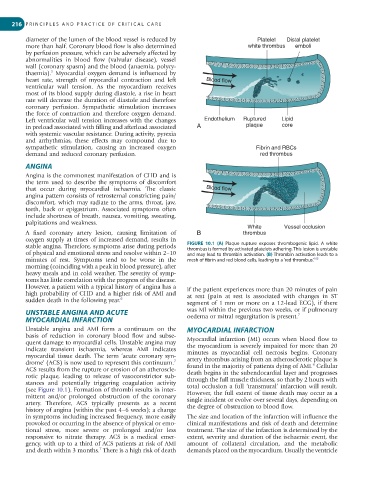
         stable angina. Therefore, symptoms arise during periods   FIGURE  10.1  (A)  Plaque  rupture  exposes  thrombogenic  lipid.  A  white
                                                              thrombus is formed by activated platelets adhering. This lesion is unstable
         of physical and emotional stress and resolve within 2–10   and may lead to thrombin activation. (B) Thrombin activation leads to a
         minutes  of  rest.  Symptoms  tend  to  be  worse  in  the   mesh of fibrin and red blood cells, leading to a ‘red thrombus’.
                                                                                                        105
         morning (coinciding with a peak in blood pressure), after
         heavy meals and in cold weather. The severity of symp-
         toms has little correlation with the progress of the disease.
         However, a patient with a typical history of angina has a   if the patient experiences more than 20 minutes of pain
         high probability of CHD and a higher risk of AMI and   at  rest  (pain  at  rest  is  associated  with  changes  in  ST
         sudden death in the following year. 6                segment of 1 mm or more on a 12-lead ECG), if there

         UNSTABLE ANGINA AND ACUTE                            was MI within the previous two weeks, or if pulmonary
                                                                                                  7
                                                              oedema or mitral regurgitation is present.
         MYOCARDIAL INFARCTION
         Unstable  angina  and  AMI  form  a  continuum  on  the   MYOCARDIAL INFARCTION
         basis  of  reduction  in  coronary  blood  flow  and  subse-  Myocardial  infarction  (MI)  occurs  when  blood  flow  to
         quent damage to myocardial cells. Unstable angina may   the myocardium is severely impaired for more than 20
         indicate  transient  ischaemia,  whereas  AMI  indicates   minutes  as  myocardial  cell  necrosis  begins.  Coronary
         myocardial  tissue  death.  The  term  ‘acute  coronary  syn-  artery thrombus arising from an atherosclerotic plaque is
                                                          7
         drome’ (ACS) is now used to represent this continuum.    found in the majority of patients dying of AMI.  Cellular
                                                                                                       8
         ACS results from the rupture or erosion of an atheroscle-  death begins in the subendocardial layer and progresses
         rotic  plaque,  leading  to  release  of  vasoconstrictor  sub-  through the full muscle thickness, so that by 2 hours with
         stances  and  potentially  triggering  coagulation  activity   total occlusion a full ‘transmural’ infarction will result.
         (see Figure 10.1). Formation of thrombi results in inter-  However, the full extent of tissue death may occur as a
         mittent  and/or  prolonged  obstruction  of  the  coronary   single incident or evolve over several days, depending on
         artery.  Therefore,  ACS  typically  presents  as  a  recent   the degree of obstruction to blood flow.
         history of angina (within the past 4–6 weeks); a change
         in symptoms including increased frequency, more easily   The size and location of the infarction will influence the
         provoked or occurring in the absence of physical or emo-  clinical manifestations and risk of death and determine
         tional  stress,  more  severe  or  prolonged  and/or  less   treatment. The size of the infarction is determined by the
         responsive  to  nitrate  therapy.  ACS  is  a  medical  emer-  extent, severity and duration of the ischaemic event, the
         gency, with up to a third of ACS patients at risk of AMI   amount  of  collateral  circulation,  and  the  metabolic
                                  7
         and death within 3 months.  There is a high risk of death   demands placed on the myocardium. Usually the ventricle

