


Page 282 - ACCCN's Critical Care Nursing
P. 282
Cardiac Rhythm Assessment and Management  259


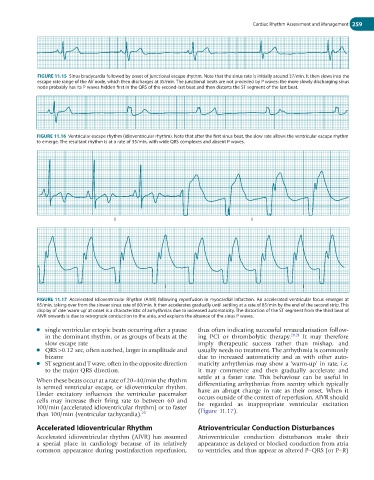
             FIGURE 11.15  Sinus bradycardia followed by onset of junctional escape rhythm. Note that the sinus rate is initially around 37/min. It then slows into the
             escape rate range of the AV node, which then discharges at 35/min. The junctional beats are not preceded by P waves: the more slowly discharging sinus
             node probably has its P waves hidden first in the QRS of the second-last beat and then distorts the ST segment of the last beat.


             FIGURE 11.16  Ventricular escape rhythm (idioventricular rhythm). Note that after the first sinus beat, the slow rate allows the ventricular escape rhythm
             to emerge. The resultant rhythm is at a rate of 35/min, with wide QRS complexes and absent P waves.


                                      I                                            I


                                                       I                                            I
             FIGURE 11.17  Accelerated Idioventricular Rhythm (AIVR) following reperfusion in myocardial infarction. An accelerated ventricular focus emerges at
             65/min, taking over from the slower sinus rate of 60/min. It then accelerates gradually until settling at a rate of 85/min by the end of the second strip. This
             display of rate ‘warm-up’ at onset is a characteristic of arrhythmias due to increased automaticity. The distortion of the ST segment from the third beat of
             AIVR onwards is due to retrograde conduction to the atria, and explains the absence of the sinus P waves.
             ●  single ventricular ectopic beats occurring after a pause   thus often indicating successful revascularisation follow-
                in the dominant rhythm, or as groups of beats at the   ing  PCI  or  thrombolytic  therapy. 20,21   It  may  therefore
                slow escape rate                                  imply  therapeutic  success  rather  than  mishap,  and
             ●  QRS >0.12 sec, often notched, larger in amplitude and   usually needs no treatment. The arrhythmia is commonly
                bizarre                                           due  to  increased  automaticity  and  as  with  other  auto-
             ●  ST segment and T wave, often in the opposite direction   maticity arrhythmias may show a ‘warm-up’ in rate, i.e.
                to the major QRS direction.                       it  may  commence  and  then  gradually  accelerate  and
                                                                  settle  at  a  faster  rate.  This  behaviour  can  be  useful  in
             When these beats occur at a rate of 20–40/min the rhythm   differentiating arrhythmias from reentry which typically
             is  termed  ventricular  escape,  or  idioventricular  rhythm.   have  an  abrupt  change  in  rate  as  their  onset.  When  it
             Under  excitatory  influences  the  ventricular  pacemaker   occurs outside of the context of reperfusion, AIVR should
             cells  may  increase  their  firing  rate  to  between  60  and     be  regarded  as  inappropriate  ventricular  excitation
             100/min (accelerated idioventricular rhythm) or to faster   (Figure  11.17).
             than 100/min (ventricular tachycardia). 20
             Accelerated Idioventricular Rhythm                   Atrioventricular Conduction Disturbances
             Accelerated idioventricular rhythm (AIVR) has assumed     Atrioventricular  conduction  disturbances  make  their
             a  special  place  in  cardiology  because  of  its  relatively   appearance as delayed or blocked conduction from atria
             common appearance during postinfarction reperfusion,   to ventricles, and thus appear as altered P–QRS (or P–R)

