


Page 300 - ACCCN's Critical Care Nursing
P. 300
Cardiac Rhythm Assessment and Management  277


                           68                                                                 60


                                85/50


                                                                                                70

                                                                                                 125/65


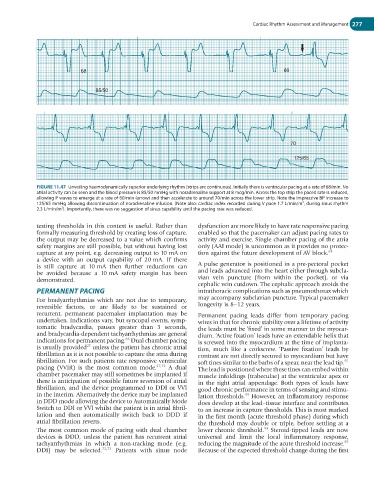
             FIGURE 11.47  Unveiling haemodynamically superior underlying rhythm (strips are continuous). Initially there is ventricular pacing at a rate of 68/min. No
             atrial activity can be seen and the blood pressure is 85/50 mmHg with noradrenaline support at 8 mcg/min. Across the top strip the paced rate is reduced,
             allowing P waves to emerge at a rate of 60/min (arrow) and then accelerate to around 70/min across the lower strip. Note the impressive BP increase to
                                                                                                    2
             125/65 mmHg allowing discontinuation of noradrenaline infusion. (Note also: cardiac index recorded during V pace 1.7 L/min/m , during sinus rhythm
                     2
             2.3 L/min/m ). Importantly, there was no suggestion of sinus capability until the pacing rate was reduced.
             testing thresholds in this context is useful. Rather than   dysfunction are more likely to have rate responsive pacing
             formally measuring threshold by creating loss of capture,   enabled so that the pacemaker can adjust pacing rates to
             the output may be decreased to a value which confirms   activity and exercise. Single chamber pacing of the atria
             safety margins are still possible, but without having lost   only (AAI mode) is uncommon as it provides no protec-
             capture at any point, e.g. decreasing output to 10 mA on   tion against the future development of AV block. 63
             a  device  with  an  output  capability  of  20 mA.  If  there
             is  still  capture  at  10 mA  then  further  reductions  can    A pulse generator is positioned in a pre-pectoral pocket
             be  avoided  because  a  10 mA  safety  margin  has  been   and leads advanced into the heart either through subcla-
             demonstrated.                                        vian  vein  puncture  (from  within  the  pocket),  or  via
                                                                  cephalic vein cutdown. The cephalic approach avoids the
             PERMANENT PACING                                     intrathoracic complications such as pneumothorax which
             For  bradyarrhythmias  which  are  not  due  to  temporary,   may accompany subclavian puncture. Typical pacemaker
             reversible  factors,  or  are  likely  to  be  sustained  or    longevity is 8–12 years.
             recurrent,  permanent  pacemaker  implantation  may  be   Permanent  pacing  leads  differ  from  temporary  pacing
             undertaken. Indications vary, but syncopal events, symp-  wires in that for chronic stability over a lifetime of activity
             tomatic  bradycardia,  pauses  greater  than  3  seconds,    the leads must be ‘fixed’ in some manner to the myocar-
             and bradycardia-dependent tachyarrhythmias are general   dium. ‘Active fixation’ leads have an extendable helix that
                                          63
             indications for permanent pacing.  Dual chamber pacing   is screwed into the myocardium at the time of implanta-
                             27
             is usually provided  unless the patient has chronic atrial   tion,  much  like  a  corkscrew.  ‘Passive  fixation’  leads  by
             fibrillation as it is not possible to capture the atria during   contrast are not directly secured to myocardium but have
             fibrillation. For such patients rate responsive ventricular   soft tines similar to the barbs of a spear, near the lead tip.
                                                                                                                  55
             pacing  (VVIR)  is  the  most  common  mode. 27,72   A  dual   The lead is positioned where these tines can embed within
             chamber pacemaker may still sometimes be implanted if   muscle infoldings (trabeculae) at the ventricular apex or
             there is anticipation of possible future reversion of atrial   in  the  right  atrial  appendage.  Both  types  of  leads  have
             fibrillation, and the device programmed to DDI or VVI   good chronic performance in terms of sensing and stimu-
             in the interim. Alternatively the device may be implanted   lation thresholds.  However, an inflammatory response
                                                                                 55
             in DDD mode allowing the device to Automatically Mode   does develop at the lead–tissue interface and contributes
             Switch to DDI or VVI whilst the patient is in atrial fibril-  to an increase in capture thresholds. This is most marked
             lation  and  then  automatically  switch  back  to  DDD  if   in the first month (acute threshold phase) during which
             atrial fibrillation reverts.                         the threshold may double or triple, before settling at a
                                                                                       55
             The most common mode of pacing with dual chamber     lower chronic threshold.  Steroid-tipped leads are now
             devices  is  DDD,  unless  the  patient  has  recurrent  atrial   universal  and  limit  the  local  inflammatory  response,
                                                                                                                  55
             tachyarrhythmias  in  which  a  non-tracking  mode  (e.g.   reducing the magnitude of the acute threshold increase.
             DDI)  may  be  selected. 72,73   Patients  with  sinus  node   Because of the expected threshold change during the first

