


Page 330 - ACCCN's Critical Care Nursing
P. 330
Cardiac Surgery and Transplantation  307


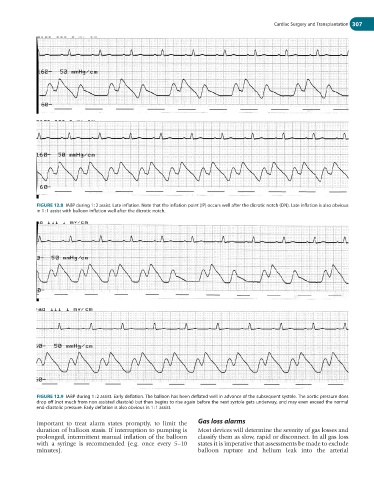
             FIGURE 12.8  IABP during 1 : 2 assist. Late inflation. Note that the inflation point (IP) occurs well after the dicrotic notch (DN). Late inflation is also obvious
             in 1 : 1 assist with balloon inflation well after the dicrotic notch.


             FIGURE 12.9  IABP during 1 : 2 assist. Early deflation. The balloon has been deflated well in advance of the subsequent systole. The aortic pressure does
             drop off (not much from non assisted diastole) but then begins to rise again before the next systole gets underway, and may even exceed the normal
             end-diastolic pressure. Early deflation is also obvious in 1 : 1 assist.


             important  to  treat  alarm  states  promptly,  to  limit  the   Gas loss alarms
             duration of balloon stasis. If interruption to pumping is   Most devices will determine the severity of gas losses and
             prolonged, intermittent manual inflation of the balloon   classify them as slow, rapid or disconnect. In all gas loss
             with  a  syringe  is  recommended  (e.g.  once  every  5–10   states it is imperative that assessments be made to exclude
             minutes).                                            balloon  rupture  and  helium  leak  into  the  arterial

