


Page 331 - ACCCN's Critical Care Nursing
P. 331
308  P R I N C I P L E S   A N D   P R A C T I C E   O F   C R I T I C A L   C A R E


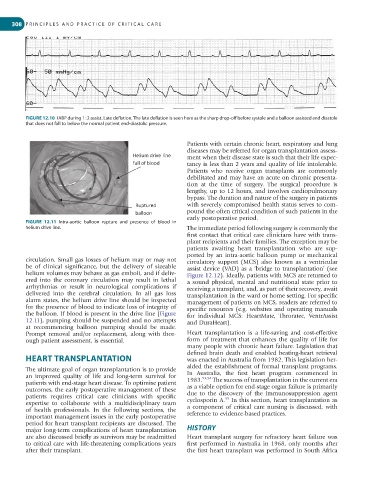
         FIGURE 12.10  IABP during 1 : 2 assist. Late deflation. The late deflation is seen here as the sharp drop-off before systole and a balloon assisted end diastole
         that does not fall to below the normal patient end-diastolic pressure.


                                                              Patients with certain chronic heart, respiratory and lung
                                                              diseases may be referred for organ transplantation assess-
                                             ,ĞůŝƵŵ ĚƌŝǀĞ ůŝŶĞ   ment when their disease state is such that their life expec-
                                             ĨƵůů ŽĨ ďůŽŽĚ    tancy is less than 2 years and quality of life intolerable.
                                                              Patients  who  receive  organ  transplants  are  commonly
                                                              debilitated and may have an acute on chronic presenta-
                                                              tion  at  the  time  of  surgery.  The  surgical  procedure  is
                                                              lengthy, up to 12 hours, and involves cardiopulmonary
                                                              bypass. The duration and nature of the surgery in patients
                                             ZƵƉƚƵƌĞĚ         with severely compromised health status serves to com-
                                              ďĂůůŽŽŶ         pound the often critical condition of such patients in the
                                                              early postoperative period.
         FIGURE  12.11  Intra-aortic  balloon  rupture  and  presence  of  blood  in
         helium drive line.                                   The immediate period following surgery is commonly the
                                                              first contact that critical care clinicians have with trans-
                                                              plant recipients and their families. The exception may be
                                                              patients  awaiting  heart  transplantation  who  are  sup-
                                                              ported  by  an  intra-aortic  balloon  pump  or  mechanical
         circulation. Small gas losses of helium may or may not   circulatory  support  (MCS)  also  known  as  a  ventricular
         be  of  clinical  significance,  but  the  delivery  of  sizeable   assist device (VAD) as a ‘bridge to transplantation’ (see
         helium volumes may behave as gas emboli, and if deliv-  Figure 12.12). Ideally, patients with MCS are returned to
         ered  into  the  coronary  circulation  may  result  in  lethal   a  sound  physical,  mental  and  nutritional  state  prior  to
         arrhythmias  or  result  in  neurological  complications  if   receiving a transplant, and, as part of their recovery, await
         delivered  into  the  cerebral  circulation.  In  all  gas  loss   transplantation in the ward or home setting. For specific
         alarm states, the helium drive line should be inspected   management of patients on MCS, readers are referred to
         for the presence of blood to indicate loss of integrity of   specific  resources  (e.g.  websites  and  operating  manuals
         the balloon. If blood is present in the drive line (Figure   for  individual  MCS:  HeartMate,  Throratec,  VentrAssist
         12.11), pumping should be suspended and no attempts   and DuraHeart).
         at  recommencing  balloon  pumping  should  be  made.
         Prompt  removal  and/or  replacement,  along  with  thor-  Heart  transplantation  is  a  life-saving  and  cost-effective
         ough patient assessment, is essential.               form  of  treatment  that  enhances  the  quality  of  life  for
                                                              many people with chronic heart failure. Legislation that
                                                              defined brain death and enabled beating-heart retrieval
         HEART TRANSPLANTATION                                was enacted in Australia from 1982. This legislation her-
                                                              alded the establishment of formal transplant programs.
         The ultimate goal of organ transplantation is to provide
         an  improved  quality  of  life  and  long-term  survival  for   In  Australia,  the  first  heart  program  commenced  in
                                                                   53,54
         patients with end-stage heart disease. To optimise patient   1983.   The success of transplantation in the current era
         outcomes, the early postoperative management of these   as a viable option for end-stage organ failure is primarily
         patients  requires  critical  care  clinicians  with  specific   due  to  the  discovery  of  the  immunosuppression  agent
                                                                           55
         expertise  to  collaborate  with  a  multidisciplinary  team    cyclosporin A.  In this section, heart transplantation as
         of  health  professionals.  In  the  following  sections,  the   a  component  of  critical  care  nursing  is  discussed,  with
         important management issues in the early postoperative   reference to evidence-based practices.
         period for heart transplant recipients are discussed. The
         major long-term complications of heart transplantation   HISTORY
         are also discussed briefly as survivors may be readmitted   Heart transplant surgery for refractory heart failure was
         to critical care with life-threatening complications years   first performed in Australia in 1968, only months after
         after their transplant.                              the first heart transplant was performed in South Africa

