


Page 357 - ACCCN's Critical Care Nursing
P. 357
334  P R I N C I P L E S   A N D   P R A C T I C E   O F   C R I T I C A L   C A R E


          From                                                interruption to these vital cellular activities is a reduction
          pulmonary     Airway                                in organ or tissue function, which in turn compromises
          artery                                   Impaired   system and body functions.
                                                   ventilation
                          Alveolus                            Changes to the oxyhaemoglobin dissociation curve also
                                                              occur in states related to hypoxia. The curve shifts to the
                                                              right when there is acidosis and/or raised levels of PCO 2
                                                              as  commonly  seen  in  respiratory  failure.  Although  this
          Alveolocapillary                                    change may alter patient oxygen saturation readings, the
            membrane       To                   Hypoxaemia    increased  release  of  oxygen  from  haemoglobin  to  the
          Normal V/Q  pulmonary vein  Low V/Q                 tissues  has  obvious benefits  for  tissue  oxygenation and
                                                              cellular metabolism. 7

                        Blocked     Impaired perfusion        Compensatory Mechanisms to
                        ventiation                            Optimise Oxygenation
                                                 Alveolar
                          Collapsed              dead space   When PO 2  in the alveolus is reduced, hypoxic pulmonary
                          alveous
                                                              vasoconstriction  occurs,  with  contraction  of  smooth
                                                              muscles  in  the  small  arterioles  in  the  hypoxic  region,
                                                              directing blood flow away from the hypoxic area of the
                                                              lung.  Peripheral chemoreceptors also detect hypoxaemia
                                                                   7
                                                              and initiate compensatory mechanisms to optimise cel-
                        Hypoxaemia              Hypoxaemia    lular oxygen delivery. Initial responses are increased respi-
          Shunt (very low) V/Q     High V/Q                   ratory rate and depth of breathing, resulting in increased
                                                              minute  ventilation,  and  raised  heart  rate  with  possible
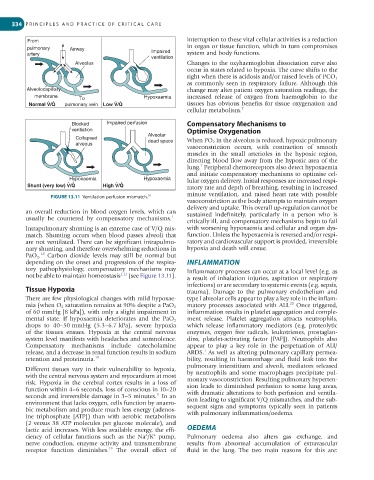
                  FIGURE 13.11  Ventilation perfusion mismatch.
                                                 18
                                                              vasoconstriction as the body attempts to maintain oxygen
                                                              delivery and uptake. This overall up-regulation cannot be
         an overall reduction in blood oxygen levels, which can   sustained  indefinitely,  particularly  in  a  person  who  is
         usually  be  countered  by  compensatory  mechanisms. 1
                                                              critically ill, and compensatory mechanisms begin to fail
         Intrapulmonary shunting is an extreme case of V/Q mis-  with worsening hypoxaemia and cellular and organ dys-
         match. Shunting occurs when blood passes alveoli that   function. Unless the hypoxaemia is reversed and/or respi-
         are not ventilated. There can be significant intrapulmo-  ratory and cardiovascular support is provided, irreversible
         nary shunting, and therefore overwhelming reductions in   hypoxia and death will ensue.
              18
         PaO 2 .   Carbon  dioxide  levels  may  still  be  normal  but
         depending on the onset and progression of the respira-  INFLAMMATION
         tory  pathophysiology,  compensatory  mechanisms  may   Inflammatory processes can occur at a local level (e.g. as
         not be able to maintain homeostasis 1,11  (see Figure 13.11).  a  result  of  inhalation  injuries,  aspiration  or  respiratory
                                                              infections) or are secondary to systemic events (e.g. sepsis,
         Tissue Hypoxia                                       trauma).  Damage  to  the  pulmonary  endothelium  and
         There are few physiological changes with mild hypoxae-  type I alveolar cells appear to play a key role in the inflam-
                                                                                                20
         mia (when O 2  saturation remains at 90% despite a PaO 2    matory processes associated with ALI.  Once triggered,
         of 60 mmHg [8 kPa]), with only a slight impairment in   inflammation results in platelet aggregation and comple-
         mental  state.  If  hypoxaemia  deteriorates  and  the  PaO 2    ment  release.  Platelet  aggregation  attracts  neutrophils,
         drops  to  40–50 mmHg  (5.3–6.7 kPa),  severe  hypoxia     which  release  inflammatory  mediators  (e.g.  proteolytic
         of  the  tissues  ensues.  Hypoxia  at  the  central  nervous   enzymes,  oxygen  free  radicals,  leukotrienes,  prostaglan-
         system level manifests with headaches and somnolence.   dins,  platelet-activating  factor  [PAF]).  Neutrophils  also
         Compensatory  mechanisms  include  catecholamine     appear  to  play  a  key  role  in  the  perpetuation  of  ALI/
                                                                    1
         release, and a decrease in renal function results in sodium   ARDS.  As well as altering pulmonary capillary permea-
         retention and proteinuria. 19                        bility, resulting in haemorrhage and fluid leak into the
                                                              pulmonary  interstitium  and  alveoli,  mediators  released
         Different  tissues  vary  in  their  vulnerability  to  hypoxia,
         with the central nervous system and myocardium at most   by  neutrophils  and  some  macrophages  precipitate  pul-
         risk.  Hypoxia  in  the  cerebral  cortex  results  in  a  loss  of   monary vasoconstriction. Resulting pulmonary hyperten-
         function within 4–6 seconds, loss of conscious in 10–20   sion leads to diminished perfusion to some lung areas,
         seconds and irreversible damage in 3–5 minutes.  In an   with dramatic alterations to both perfusion and ventila-
                                                    11
         environment that lacks oxygen, cells function by anaero-  tion leading to significant V/Q mismatches, and the sub-
         bic metabolism and produce much less energy (adenos-  sequent  signs  and  symptoms  typically  seen  in  patients
         ine  triphosphate  [ATP])  than  with  aerobic  metabolism    with pulmonary inflammation/oedema.
         (2 versus 38 ATP molecules per glucose molecule), and
         lactic acid increases. With less available energy, the effi-  OEDEMA
                                                   +
                                                 +
         ciency  of  cellular  functions  such  as  the  Na /K   pump,   Pulmonary  oedema  also  alters  gas  exchange,  and
         nerve  conduction,  enzyme  activity  and  transmembrane   results  from  abnormal  accumulation  of  extravascular
         receptor  function  diminishes.   The  overall  effect  of   fluid  in  the  lung.  The  two  main  reasons  for  this  are:
                                     19

