


Page 360 - ACCCN's Critical Care Nursing
P. 360
Respiratory Assessment and Monitoring 337


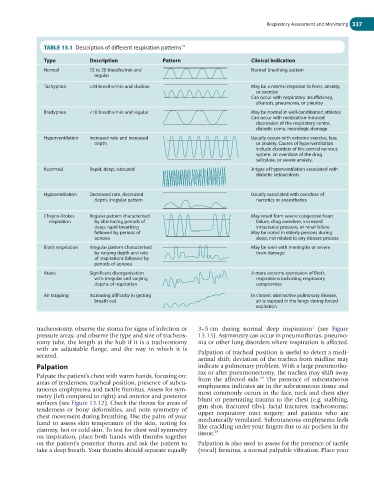
               TABLE 13.1  Description of different respiration patterns 14

               Type           Description             Pattern                      Clinical indication
               Normal         12 to 20 breaths/min and                             Normal breathing pattern
                                regular
               Tachypnea      >24 breaths/min and shallow                          May be a normal response to fever, anxiety,
                                                                                     or exercise
                                                                                   Can occur with respiratory insufficiency,
                                                                                     alkalosis, pneumonia, or pleurisy
               Bradypnea      <10 breaths/min and regular                          May be normal in well-conditioned athletes
                                                                                   Can occur with medication-induced
                                                                                     depression of the respiratory centre,
                                                                                     diabetic coma, neurologic damage
               Hyperventilation  Increased rate and increased                      Usually occurs with extreme exercise, fear,
                                depth                                                or anxiety. Causes of hyperventilation
                                                                                     include disorders of the central nervous
                                                                                     system, an overdose of the drug
                                                                                     salicylate, or severe anxiety.
               Kussmaul       Rapid, deep, laboured                                A type of hyperventilation associated with
                                                                                     diabetic ketoacidosis


               Hypoventilation  Decreased rate, decreased                          Usually associated with overdose of
                                depth, irregular pattern                             narcotics or anaesthetics

               Cheyne-Stokes   Regular pattern characterised                       May result form severe congestive heart
                 respiration    by alternating periods of                            failure, drug overdose, increased
                                deep, rapid breathing                                intracranial pressure, or renal failure
                                followed by periods of                             May be noted in elderly persons during
                                apnoea                                               sleep, not related to any disease process
               Biot’s respiration  Irregular pattern characterised                 May be seen with meningitis or severe
                                by varying depth and rate                            brain damage
                                of respirations followed by
                                periods of apnoea
               Ataxic         Significant disorganisation                          A more extreme expression of Biot’s
                                with irregular and varying                           respirations indicating respiratory
                                depths of respiration                                compromise

               Air trapping   Increasing difficulty in getting                     In chronic obstructive pulmonary disease,
                                breath out                                           air is trapped in the lungs during forced
                                                                                     expiration


             tracheostomy, observe the stoma for signs of infection or   3–5 cm  during  normal  deep  inspiration   (see  Figure
                                                                                                       1
             pressure areas; and observe the type and size of tracheos-  13.13). Asymmetry can occur in pneumothorax, pneumo-
             tomy tube, the length at the hub if it is a tracheostomy   nia or other lung disorders where inspiration is affected.
             with  an  adjustable  flange,  and  the  way  in  which  it  is
             secured.                                             Palpation of tracheal position is useful to detect a medi-
                                                                  astinal shift; deviation of the trachea from midline may
             Palpation                                            indicate a pulmonary problem. With a large pneumotho-
             Palpate the patient’s chest with warm hands, focusing on:   rax or after pneumonectomy, the trachea may shift away
                                                                                      28
             areas of tenderness, tracheal position, presence of subcu-  from  the  affected  side.   The  presence  of  subcutaneous
             taneous emphysema and tactile fremitus. Assess for sym-  emphysema indicates air in the subcutaneous tissue and
             metry (left compared to right) and anterior and posterior   most commonly occurs in the face, neck and chest after
             surfaces (see Figure 13.12). Check the thorax for areas of   blunt or penetrating trauma to the chest (e.g. stabbing,
             tenderness  or  bony  deformities,  and  note  symmetry  of   gun shot, fractured ribs); facial fractures; tracheostomy;
             chest movement during breathing. Use the palm of your   upper  respiratory  tract  surgery;  and  patients  who  are
             hand to assess skin temperature of the skin, noting for   mechanically ventilated. Subcutaneous emphysema feels
             clammy, hot or cold skin. To test for chest wall symmetry   like crackling under your fingers due to air pockets in the
                                                                       29
             on inspiration, place both hands with thumbs together   tissue.
             on the patient’s posterior thorax and ask the patient to   Palpation is also used to assess for the presence of tactile
             take a deep breath. Your thumbs should separate equally   (vocal) fremitus, a normal palpable vibration. Place your

