


Page 363 - ACCCN's Critical Care Nursing
P. 363
340  P R I N C I P L E S   A N D   P R A C T I C E   O F   C R I T I C A L   C A R E

            NORMAL SIGNAL                                     ●  Pulse oximeters are relatively reliable when the SaO 2
                                                                 is 90% or above, however accuracy deteriorates when
                                                                                            33
                                                                 the  SaO 2   falls  to  80%  or  less.   When  SpO 2   appear
                                                                 abnormal, assess the ABGs.
                                                              ●  As  satisfactory  arterial  perfusion  of  the  monitoring
                                                                 area  is  required,  low  cardiac  output  states,  vasocon-
                                                                 striction, peripheral vascular disease and hypothermia
           MOTION ARTEFACT                                       can  cause  inaccurate  pulse  signals  and  falsely  low
                                                                 oxygen  saturation  readings.  In  these  cases,  confirm
                                                                 oxygen saturation with intermittent arterial blood gas
                                                                 testing.
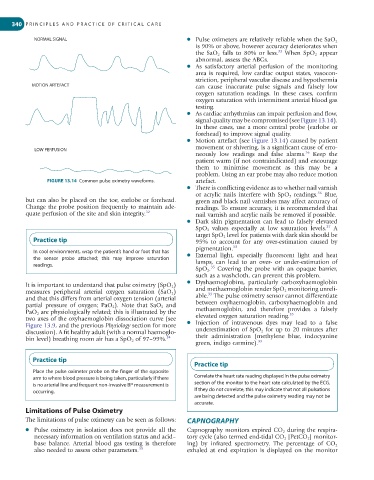
                                                              ●  As cardiac arrhythmias can impair perfusion and flow,
                                                                 signal quality may be compromised (see Figure 13.14).
                                                                 In these cases, use a more central probe (earlobe or
                                                                 forehead) to improve signal quality.
                                                              ●  Motion artefact (see Figure 13.14) caused by patient
            LOW PERFUSION                                        movement or shivering, is a significant cause of erro-
                                                                                                     36
                                                                 neously  low  readings  and  false  alarms.   Keep  the
                                                                 patient warm (if not contraindicated) and encourage
                                                                 them  to  minimise  movement  as  this  may  be  a
                                                                 problem. Using an ear probe may also reduce motion
                FIGURE 13.14  Common pulse oximetry waveforms.   artefact.
                                                              ●  There is conflicting evidence as to whether nail varnish
                                                                                                         36
                                                                 or  acrylic  nails  interfere  with  SpO 2   readings.   Blue,
         but can also be placed on the toe, earlobe or forehead.   green and black nail varnishes may affect accuracy of
         Change the probe position frequently to maintain ade-   readings. To ensure accuracy, it is recommended that
         quate perfusion of the site and skin integrity. 32      nail varnish and acrylic nails be removed if possible.
                                                              ●  Dark  skin  pigmentation  can  lead  to  falsely  elevated
                                                                                                            37
                                                                 SpO 2   values  especially  at  low  saturation  levels.   A
                                                                 target SpO 2  level for patients with dark skin should be
            Practice tip                                         95%  to  account  for  any  over-estimation  caused  by
                                                                 pigmentation. 33
            In cool environments, wrap the patient’s hand or foot that has
            the  sensor  probe  attached;  this  may  improve  saturation   ●  External  light,  especially  fluorescent  light  and  heat
            readings.                                            lamps,  can  lead  to  an  over-  or  under-estimation  of
                                                                      35
                                                                 SpO 2 .   Covering  the  probe  with  an  opaque  barrier,
                                                                 such as a washcloth, can prevent this problem.
                                                              ●  Dyshaemoglobins,  particularly  carboxyhaemoglobin
         It is important to understand that pulse oximetry (SpO 2 )
         measures  peripheral  arterial  oxygen  saturation  (SaO 2 )   and methaemoglobin render SpO 2  monitoring unreli-
                                                                     33
         and that this differs from arterial oxygen tension (arterial   able.  The pulse oximetry sensor cannot differentiate
         partial  pressure  of  oxygen;  PaO 2 ).  Note  that  SaO 2   and   between oxyhaemoglobin, carboxyhaemoglobin and
         PaO 2  are physiologically related; this is illustrated by the   methaemoglobin,  and  therefore  provides  a  falsely
                                                                                                35
         two axes of the oxyhaemoglobin dissociation curve (see   elevated oxygen saturation reading.
         Figure 13.9, and the previous Physiology section for more   ●  Injection  of  intravenous  dyes  may  lead  to  a  false
         discussion). A fit healthy adult (with a normal haemoglo-  underestimation of SpO 2  for up to 20 minutes after
         bin level) breathing room air has a SpO 2  of 97–99%. 34  their  administration  (methylene  blue,  indocyanine
                                                                 green, indigo carmine). 33

            Practice tip
                                                                 Practice tip
            Place the pulse oximeter probe on the finger of the opposite
            arm to where blood pressure is being taken, particularly if there   Correlate the heart rate reading displayed in the pulse oximetry
            is no arterial line and frequent non-invasive BP measurement is   section of the monitor to the heart rate calculated by the ECG.
            occurring.                                           If they do not correlate, this may indicate that not all pulsations
                                                                 are being detected and the pulse oximetry reading may not be
                                                                 accurate.
         Limitations of Pulse Oximetry
         The limitations of pulse oximetry can be seen as follows:  CAPNOGRAPHY
         ●  Pulse oximetry in isolation does not provide all the   Capnography monitors expired CO 2  during the respira-
            necessary information on ventilation status and acid–  tory cycle (also termed end-tidal CO 2  [PetCO 2 ] monitor-
            base  balance.  Arterial  blood  gas  testing  is  therefore   ing)  by  infrared  spectrometry.  The  percentage  of  CO 2
            also needed to assess other parameters. 35        exhaled  at  end  expiration  is  displayed  on  the  monitor

