


Page 390 - ACCCN's Critical Care Nursing
P. 390
Respiratory Alterations and Management  367


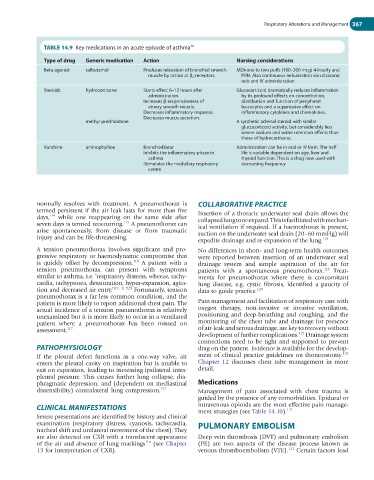
               TABLE 14.9  Key medications in an acute episode of asthma 58

               Type of drug  Generic medication  Action                       Nursing considerations
               Beta-agonist  salbutamol         Produces relaxation of bronchial smooth   MDI-one to two puffs (100–200 mcg) 4-hourly and
                                                  muscle by action at β 2 -receptors.  PRN. Also continuous nebulisation via ultrasonic
                                                                                neb and IV administration
               Steroids      hydrocortisone     Starts effect 6–12 hours after   Glucocorticoid dramatically reduces inflammation
                                                  administration.               by its profound effects on concentration,
                                                Increases β-responsiveness of   distribution and function of peripheral
                                                  airway smooth muscle.         leucocytes and a suppressive effect on
                                                Decreases inflammatory response.  inflammatory cytokines and chemokines.
                                                Decreases mucus secretion.
                             methyl-prednisolone                              A synthetic adrenal steroid with similar
                                                                                glucocorticoid activity, but considerably less
                                                                                severe sodium and water retention effects than
                                                                                those of hydrocortisone.
               Xanthine      aminophylline      Bronchodilator                Administration can be in oral or IV form. The half
                                                Inhibits the inflammatory phase in   life is variable dependent on age, liver and
                                                  asthma                        thyroid function. This is a drug now used with
                                                Stimulates the medullary respiratory   decreasing frequency
                                                  centre


             normally  resolves  with  treatment.  A  pneumothorax  is   COLLABORATIVE PRACTICE
             termed persistent if the air leak lasts for more than five   Insertion of a thoracic underwater seal drain allows the
             days,   while  one  reappearing  on  the  same  side  after   collapsed lung to re-expand. This is facilitated with mechan-
                 114
                                          115
             seven days is termed reoccurring.  A pneumothorax can   ical ventilation if required. If a haemothorax is present,
             arise  spontaneously,  from  disease  or  from  traumatic   suction on the underwater seal drain (20–60 mmHg) will
             injury and can be life-threatening.
                                                                  expedite drainage and re-expansion of the lung. 118
             A  tension  pneumothorax  involves  significant  and  pro-  No differences in short- and long-term health outcomes
             gressive respiratory or haemodynamic compromise that   were  reported  between  insertion  of  an  underwater  seal
                                             116
             is  quickly  offset  by  decompression.   A  patient  with  a   drainage  system  and  simple  aspiration  of  the  air  for
             tension  pneumothorax  can  present  with  symptoms   patients  with  a  spontaneous  pneumothorax.   Treat-
                                                                                                           119
             similar to asthma, i.e. ‘respiratory distress, wheeze, tachy-  ments  for  pneumothorax  where  there  is  concomitant
             cardia, tachypnoea, desaturation, hyper-expansion, agita-  lung  disease,  e.g.  cystic  fibrosis,  identified  a  paucity  of

             tion and decreased air entry.’ 117, p. 525  Fortunately, tension   data to guide practice. 120
             pneumothorax is a far less common condition, and the
             patient is more likely to report additional chest pain. The   Pain management and facilitation of respiratory care with
             actual incidence of a tension pneumothorax is relatively   oxygen  therapy,  non-invasive  or  invasive  ventilation,
             unexamined but it is more likely to occur in a ventilated   positioning  and  deep-breathing  and  coughing,  and  the
             patient  where  a  pneumothorax  has  been  missed  on   monitoring of the chest tube and drainage for presence
             assessment. 117                                      of air-leak and serous drainage, are key to recovery without
                                                                                                   121
                                                                  development of further complications.  Drainage system
                                                                  connections need to be tight and supported to prevent
             PATHOPHYSIOLOGY                                      drag on the patient. Evidence is available for the develop-
                                                                                                                 121
             If  the  pleural  defect  functions  as  a  one-way  valve,  air   ment of clinical practice guidelines on thoracostomy.
             enters the pleural cavity on inspiration but is unable to   Chapter  12  discusses  chest  tube  management  in  more
             exit on expiration, leading to increasing ipsilateral intra-  detail.
             pleural  pressure.  This  causes  further  lung  collapse,  dia-
             phragmatic depression, and (dependent on mediastinal   Medications
             distensibility) contralateral lung compression. 117  Management  of  pain  associated  with  chest  trauma  is
                                                                  guided by the presence of any comorbidities. Epidural or
             CLINICAL MANIFESTATIONS                              intravenous opioids are the most effective pain manage-
                                                                                               121
                                                                  ment strategies (see Table 14.10).
             Severe presentations are identified by history and clinical
             examination  (respiratory  distress,  cyanosis,  tachycardia,   PULMONARY EMBOLISM
             tracheal shift and unilateral movement of the chest). They
             are also detected on CXR with a translucent appearance   Deep vein thrombosis (DVT) and pulmonary embolism
                                                 118
             of the air and absence of lung markings  (see Chapter   (PE)  are  two  aspects  of  the  disease  process  known  as
             13 for interpretation of CXR).                       venous thromboembolism (VTE). 122  Certain factors lead

