


Page 394 - ACCCN's Critical Care Nursing
P. 394
Respiratory Alterations and Management  371

                                                                  due to infection or hemidiaphragm paralysis secondary
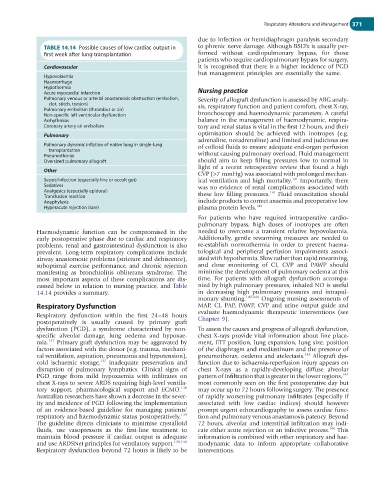
               TABLE 14.14  Possible causes of low cardiac output in   to phrenic nerve damage. Although BSLTx is usually per-
               first week after lung transplantation              formed  without  cardiopulmonary  bypass,  for  those
                                                                  patients who require cardiopulmonary bypass for surgery,
               Cardiovascular                                     it is recognised that there is a higher incidence of PGD
                                                                  but management principles are essentially the same.
               Hypovolaemia
               Haemorrhage
               Hypothermia
               Acute myocardial infarction                        Nursing practice
               Pulmonary venous or arterial anastomosis obstruction (embolism,   Severity of allograft dysfunction is assessed by ABG analy-
                 clot, stitch, torsion)                           sis, respiratory function and patient comfort, chest X-ray,
               Pulmonary embolism (thrombus or air)
               Non-specific left ventricular dysfunction          bronchoscopy and haemodynamic parameters. A careful
               Arrhythmias                                        balance in the management of haemodynamic, respira-
               Coronary artery air embolism                       tory and renal status is vital in the first 12 hours, and their
               Pulmonary                                          optimisation  should  be  achieved  with  inotropes  (e.g.
                                                                  adrenaline, noradrenaline) and limited and judicious use
               Pulmonary dynamic inflation of native lung in single-lung   of colloid fluids to ensure adequate end-organ perfusion
                 transplantation
               Pneumothorax                                       without causing pulmonary overload. Fluid management
               Oversized pulmonary allograft                      should  aim  to  keep  filling  pressures  low  to  normal  in
                                                                  light of a recent retrospective review that found a high
               Other
                                                                  CVP (>7 mmHg) was associated with prolonged mechan-
                                                                                                 141
               Sepsis/infection (especially line or occult gut)   ical ventilation and high mortality.  Importantly, there
               Sedatives                                          was no evidence of renal complications associated with
               Analgesics (especially epidural)                                          141
               Transfusion reaction                               these low filling pressures.  Fluid resuscitation should
               Anaphylaxis                                        include products to correct anaemia and preoperative low
               Hyperacute rejection (rare)                        plasma protein levels. 142
                                                                  For  patients  who  have  required  intraoperative  cardio-
                                                                  pulmonary  bypass,  high  doses  of  inotropes  are  often
             Haemodynamic  function  can  be  compromised  in  the   needed  to  overcome  a  transient  relative  hypovolaemia.
             early postoperative phase due to cardiac and respiratory   Additionally,  gentle  rewarming  measures  are  needed  to
             problems; renal and gastrointestinal dysfunction is also   re-establish  normothermia  in  order  to  prevent  haema-
             prevalent.  Long-term  respiratory  complications  include   tological  and  peripheral  perfusion  impairments  associ-
             airway anastomotic problems (stricture and dehiscence),   ated with hypothermia. Slow rather than rapid rewarming,
             suboptimal exercise performance, and chronic rejection   and  close  monitoring  of  CI,  CVP  and  PAWP  should
             manifesting  as  bronchiolitis  obliterans  syndrome.  The   minimise the development of pulmonary oedema at this
             most  important  aspects  of  these  complications  are  dis-  time.  For  patients  with  allograft  dysfunction  accompa-
             cussed below in relation to nursing practice, and Table   nied by high pulmonary pressures, inhaled NO is useful
             14.14 provides a summary.                            in  decreasing  high  pulmonary  pressures  and  intrapul-
                                                                  monary shunting. 143,144  Ongoing nursing assessments of
             Respiratory Dysfunction                              MAP,  CI,  PAP,  PAWP,  CVP  and  urine  output  guide  and
             Respiratory  dysfunction  within  the  first  24–48  hours   evaluate  haemodynamic  therapeutic  interventions  (see
                                                                  Chapter  9).
             postoperatively  is  usually  caused  by  primary  graft
             dysfunction  (PGD),  a  syndrome  characterised  by  non-  To assess the causes and progress of allograft dysfunction,
             specific  alveolar  damage,  lung  oedema  and  hypoxae-  chest X-rays provide vital information about line place-
             mia. 137  Primary graft dysfunction may be aggravated by   ment, ETT position, lung expansion, lung size, position
             factors associated with the donor (e.g. trauma, mechani-  of the diaphragm and mediastinum and the presence of
             cal ventilation, aspiration, pneumonia and hypotension),   pneumothorax, oedema and atelectasis. 145  Allograft dys-
             cold  ischaemic  storage, 137   inadequate  preservation  and   function due to ischaemia-reperfusion injury appears on
             disruption  of  pulmonary  lymphatics.  Clinical  signs  of   chest  X-rays  as  a  rapidly-developing  diffuse  alveolar
             PGD  range  from  mild  hypoxaemia  with  infiltrates  on   pattern of infiltration that is greater in the lower regions, 142
             chest X-rays to severe ARDS requiring high-level ventila-  most commonly seen on the first postoperative day but
                                                            138
             tory  support,  pharmacological  support  and  ECMO.    may occur up to 72 hours following surgery. The presence
             Australian researchers have shown a decrease in the sever-  of rapidly worsening pulmonary infiltrates (especially if
             ity and incidence of PGD following the implementation   associated  with  low  cardiac  indices)  should  however
             of  an  evidence-based  guideline  for  managing  patients’   prompt urgent echocardiography to assess cardiac func-
             respiratory and haemodynamic status postoperatively. 139    tion and pulmonary venous anastamosis patency. Beyond
             The  guideline  directs  clinicians  to  minimise  crystalloid   72 hours, alveolar and interstitial infiltration may indi-
             fluids,  use  vasopressors  as  the  first-line  treatment  to   cate either acute rejection or an infective process. 146  This
             maintain  blood  pressure  if  cardiac  output  is  adequate   information is combined with other respiratory and hae-
             and use ARDSNet principles for ventilatory support. 139,140    modynamic  data  to  inform  appropriate  collaborative
             Respiratory dysfunction beyond 72 hours is likely to be   interventions.

