


Page 393 - ACCCN's Critical Care Nursing
P. 393
370  P R I N C I P L E S   A N D   P R A C T I C E   O F   C R I T I C A L   C A R E


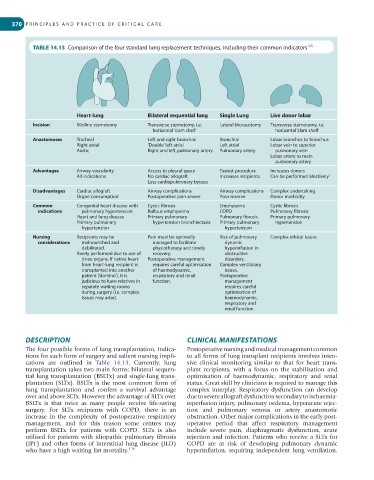
            TABLE 14.13  Comparison of the four standard lung replacement techniques, including their common indicators 135


                          Heart-lung             Bilateral sequential lung  Single Lung  Live donor lobar
            Incision      Midline sternotomy     Transverse sternotomy, i.e.   Lateral thoracotomy  Transverse sternotomy, i.e.
                                                   horizontal ‘clam shell’                 horizontal ‘clam shell’
            Anastomoses   Tracheal               Left and right bronchial  Bronchial     Lobar bronchus to bronchus
                          Right atrial           ’Double’ left atrial    Left atrial     Lobar vein to superior
                          Aortic                 Right and left pulmonary artery  Pulmonary artery  pulmonary vein
                                                                                         Lobar artery to main
                                                                                           pulmonary artery
            Advantages    Airway vascularity     Access to pleural space  Easiest procedure  Increases donors
                          All indications        No cardiac allograft    Increases recipients  Can be performed ‘electively’
                                                 Less cardiopulmonary bypass
            Disadvantages  Cardiac allograft     Airway complications    Airway complications  Complex undertaking
                          Organ ‘consumption’    Postoperative pain severe  Poor reserve  Donor morbidity
            Common        Congenital heart disease with   Cystic fibrosis  Emphysema     Cystic fibrosis
             indications    pulmonary hypertension  Bullous emphysema    COPD            Pulmonary fibrosis
                          Heart and lung disease  Primary pulmonary      Pulmonary fibrosis  Primary pulmonary
                          Primary pulmonary        hypertension bronchiectasis  Primary pulmonary   hypertension
                            hypertension                                   hypertension
            Nursing       Recipients may be      Pain must be optimally   Risk of pulmonary   Complex ethical issues
             considerations  malnourished and      managed to facilitate   dynamic
                            debilitated.           physiotherapy and timely   hyperinflation in
                          Rarely performed due to use of   recovery.       obstructive
                            three organs. If native heart   Postoperative management   disorders.
                            from heart-lung recipient is   requires careful optimisation   Complex ventilatory
                            transplanted into another   of haemodynamic,   issues.
                            patient (’domino’), it is   respiratory and renal   Postoperative
                            judicious to have relatives in   function.     management
                            separate waiting rooms                         requires careful
                            during surgery (i.e. complex                   optimisation of
                            issues may arise).                             haemodynamic,
                                                                           respiratory and
                                                                           renal function.


         DESCRIPTION                                          CLINICAL MANIFESTATIONS
         The four possible forms of lung transplantation, indica-  Postoperative nursing and medical management common
         tions for each form of surgery and salient nursing impli-  to all forms of lung transplant recipients involves inten-
         cations  are  outlined  in  Table  14.13.  Currently,  lung   sive  clinical  monitoring  similar  to  that  for  heart  trans-
         transplantation takes two main forms: bilateral sequen-  plant  recipients,  with  a  focus  on  the  stabilisation  and
         tial lung transplantation (BSLTx) and single-lung trans-  optimisation  of  haemodynamic,  respiratory  and  renal
         plantation  (SLTx).  BSLTx  is  the  most  common  form  of   status. Great skill by clinicians is required to manage this
         lung  transplantation  and  confers  a  survival  advantage   complex interplay. Respiratory dysfunction can develop
         over and above SLTx. However the advantage of SLTx over   due to severe allograft dysfunction secondary to ischaemia-
         BSLTx  is  that  twice  as  many  people  receive  life-saving   reperfusion injury, pulmonary oedema, hyperacute rejec-
         surgery.  For  SLTx  recipients  with  COPD,  there  is  an   tion  and  pulmonary  venous  or  artery  anastomotic
         increase  in  the  complexity  of  postoperative  respiratory   obstruction. Other major complications in the early post-
         management,  and  for  this  reason  some  centres  may   operative  period  that  affect  respiratory  management
         perform  BSLTx  for  patients  with  COPD.  SLTx  is  also   include  severe  pain,  diaphragmatic  dysfunction,  acute
         utilised for patients with idiopathic pulmonary fibrosis   rejection and infection. Patients who receive a SLTx for
         (IPF) and other forms of interstitial lung disease (ILD)   COPD  are  at  risk  of  developing  pulmonary  dynamic
         who have a high waiting list mortality. 136          hyperinflation,  requiring  independent  lung  ventilation.

