


Page 392 - ACCCN's Critical Care Nursing
P. 392
Respiratory Alterations and Management  369

             To prevent VTE, prophylactic interventions include hydra-  cardiac death has the potential to significantly increase
             tion and early mobilisation that, depending on the need   the  number  of  organs  available  for  lung  transplanta-
             for  patient  admission  are  not  always  possible  in  the    tion. 132   In  1985,  13  lung  transplant  procedures  were
             critical care setting. Mechanical measures of prophylaxis   reported worldwide. 133  In subsequent years, the number
             aim  to  reduce  venous  stasis  via  external  compression.   of  recipients  worldwide  has  steadily  increased  to  be  in
                                                                                        134
             Commonly employed measures include knee- or thigh-   excess  of  2700  annually.   Patients  have  received  lung
             length  graduated  compression  stockings  and/or  inter-  transplants  in  Australasia  since  the  early  1990s.  Lung
             mittent  pneumatic  compression  and/or  venous  foot   transplantation can be either single or double, depend-
             pumps.  Clinical  practice  guidelines  are  published  to   ing on a patient’s underlying disease state. In the post-
             support evidence-based care. 124  Two Cochrane systematic   operative  period,  clinicians  need  to  carefully  balance
             reviews  have  established  that  combined  modalities   fluid  management  to  optimise  respiratory  function
             reduce the incidence of DVT but the effect on PE remains   without  causing  haemodynamic  compromise  or  renal
             unknown. 127,128                                     dysfunction.  As  severe  pain,  particularly  for  transverse
                                                                  thoracotomy incisions, can compromise recovery signifi-
             Medications                                          cantly,  effective  analgesic  regimens  to  facilitate  physio-
                                                                  therapy are critical.
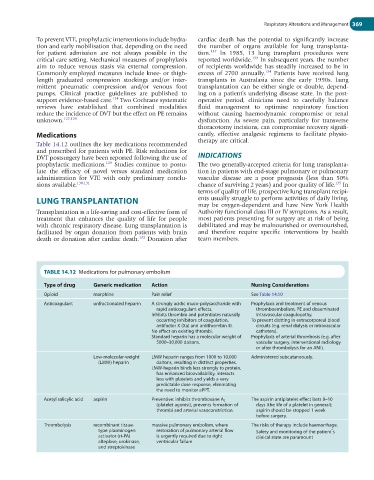
             Table 14.12 outlines the key medications recommended
             and prescribed for patients with PE. Risk reductions for
             DVT postsurgery have been reported following the use of   INDICATIONS
             prophylactic  medications. 129   Studies  continue  to  postu-  The two generally-accepted criteria for lung transplanta-
             late  the  efficacy  of  novel  versus  standard  medication   tion in patients with end-stage pulmonary or pulmonary
             administration  for  VTE  with  only  preliminary  conclu-  vascular  disease  are  a  poor  prognosis  (less  than  50%
                                                                                                               135
             sions available. 130,131                             chance of surviving 2 years) and poor quality of life.  In
                                                                  terms of quality of life, prospective lung transplant recipi-
             LUNG TRANSPLANTATION                                 ents usually struggle to perform activities of daily living,
                                                                  may  be  oxygen-dependent  and  have  New  York  Health
             Transplantation is a life-saving and cost-effective form of   Authority functional class III or IV symptoms. As a result,
             treatment  that  enhances  the  quality  of  life  for  people   most patients presenting for surgery are at risk of being
             with chronic respiratory disease. Lung transplantation is   debilitated and may be malnourished or overnourished,
             facilitated  by  organ  donation  from  patients  with  brain   and  therefore  require  specific  interventions  by  health
             death or donation after cardiac death. 132  Donation after   team members.


               TABLE 14.12  Medications for pulmonary embolism
               Type of drug     Generic medication  Action                         Nursing Considerations
               Opioid           morphine           Pain relief                     See Table 14.10
               Anticoagulant    unfractionated heparin  A strongly acidic muco-polysaccharide with   Prophylaxis and treatment of venous
                                                    rapid anticoagulant effects.     thromboembolism, PE and disseminated
                                                   Inhibits thrombin and potentiates naturally   intravascular coagulopathy.
                                                    occurring inhibitors of coagulation,   To prevent clotting in extracorporeal blood
                                                    antifactor X (Xa) and antithrombin III.  circuits (e.g. renal dialysis or intravascular
                                                   No effect on existing thrombi.    catheters).
                                                   Standard heparin has a molecular weight of   Prophylaxis of arterial thrombosis (e.g. after
                                                    5000–30,000 daltons.             vascular surgery, interventional radiology
                                                                                     or after thrombolysis for an AMI).
                                Low-molecular-weight   LMW heparin ranges from 1000 to 10,000   Administered subcutaneously.
                                 (LMW) heparin      daltons, resulting in distinct properties.
                                                   LMW-heparin binds less strongly to protein,
                                                    has enhanced bioavailability, interacts
                                                    less with platelets and yields a very
                                                    predictable dose response, eliminating
                                                    the need to monitor aPPT.
               Acetyl salicylic acid  aspirin      Preventive: inhibits thromboxane A 2   The aspirin antiplatelet effect lasts 8–10
                                                    (platelet agonist), prevents formation of   days (the life of a platelet in general);
                                                    thrombi and arterial vasoconstriction.  aspirin should be stopped 1 week
                                                                                     before surgery.
               Thrombolysis     recombinant tissue-  massive pulmonary embolism, where   The risks of therapy include haemorrhage.
                                 type plasminogen   restoration of pulmonary arterial flow    Safety and monitoring of the patient’s
                                 activator (rt-PA)   is urgently required due to right   clinical state are paramount
                                 alteplase, urokinase,   ventricular failure
                                 and streptokinase

