


Page 444 - ACCCN's Critical Care Nursing
P. 444
Neurological Assessment and Monitoring 421


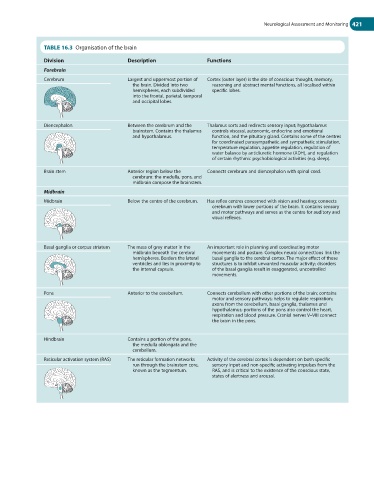
               TABLE 16.3  Organisation of the brain

               Division                    Description               Functions
               Forebrain
               Cerebrum                    Largest and uppermost portion of   Cortex (outer layer) is the site of conscious thought, memory,
                                            the brain. Divided into two   reasoning and abstract mental functions, all localised within
                                            hemispheres, each subdivided   specific lobes.
                                            into the frontal, parietal, temporal
                                            and occipital lobes.


               Diencephalon                Between the cerebrum and the   Thalamus sorts and redirects sensory input; hypothalamus
                                            brainstem. Contains the thalamus   controls visceral, autonomic, endocrine and emotional
                                            and hypothalamus.         function, and the pituitary gland. Contains some of the centres
                                                                      for coordinated parasympathetic and sympathetic stimulation,
                                                                      temperature regulation, appetite regulation, regulation of
                                                                      water balance by antidiuretic hormone (ADH), and regulation
                                                                      of certain rhythmic psychobiological activities (e.g. sleep).
               Brain stem                  Anterior region below the   Connects cerebrum and diencephalon with spinal cord.
                                            cerebrum: the medulla, pons, and
                                            midbrain compose the brainstem.
               Midbrain
               Midbrain                    Below the centre of the cerebrum.  Has reflex centres concerned with vision and hearing; connects
                                                                      cerebrum with lower portions of the brain. It contains sensory
                                                                      and motor pathways and serves as the centre for auditory and
                                                                      visual reflexes.


               Basal ganglia or corpus striatum  The mass of grey matter in the   An important role in planning and coordinating motor
                                            midbrain beneath the cerebral   movements and posture. Complex neural connections link the
                                            hemispheres. Borders the lateral   basal ganglia to the cerebral cortex. The major effect of these
                                            ventricles and lies in proximity to   structures is to inhibit unwanted muscular activity; disorders
                                            the internal capsule.     of the basal ganglia result in exaggerated, uncontrolled
                                                                      movements.


               Pons                        Anterior to the cerebellum.  Connects cerebellum with other portions of the brain; contains
                                                                      motor and sensory pathways; helps to regulate respiration;
                                                                      axons from the cerebellum, basal ganglia, thalamus and
                                                                      hypothalamus; portions of the pons also control the heart,
                                                                      respiration and blood pressure. Cranial nerves V–VIII connect
                                                                      the brain in the pons.

               Hindbrain                   Contains a portion of the pons,
                                            the medulla oblongata and the
                                            cerebellum.
               Reticular activation system (RAS)  The reticular formation networks   Activity of the cerebral cortex is dependent on both specific
                                            run through the brainstem core,   sensory input and non-specific activating impulses from the
                                            known as the tegmentum.   RAS, and is critical to the existence of the conscious state,
                                                                      states of alertness and arousal.

