


Page 512 - ACCCN's Critical Care Nursing
P. 512
Support of Renal Function 489


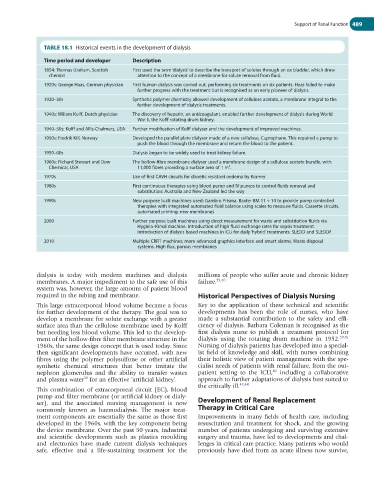
               TABLE 18.1  Historical events in the development of dialysis

               Time period and developer    Description
               1854: Thomas Graham, Scottish   First used the term ‘dialysis’ to describe the transport of solutes through an ox bladder, which drew
                 chemist                      attention to the concept of a membrane for solute removal from fluid.
               1920s: George Haas, German physician  First human dialysis was carried out, performing six treatments on six patients. Haas failed to make
                                              further progress with the treatment but is recognised as an early pioneer of dialysis.
               1920–30s                     Synthetic polymer chemistry allowed development of cellulose acetate, a membrane integral to the
                                              further development of dialysis treatments.
               1940s: Willem Kolff, Dutch physician  The discovery of heparin, an anticoagulant, enabled further development of dialysis during World
                                              War II, the Kolff rotating drum kidney.
               1940–50s: Kolff and Allis-Chalmers, USA  Further modification of Kolff dialyser and the development of improved machines.
               1950s: Fredrik Kiil, Norway  Developed the parallel plate dialyser made of a new cellulose, Cuprophane. This required a pump to
                                              push the blood through the membrane and return the blood to the patient.
               1950–60s                     Dialysis began to be widely used to treat kidney failure.
               1960s: Richard Stewart and Dow   The hollow-fibre membrane dialyser used a membrane design of a cellulose acetate bundle, with
                 Chemical, USA                11,000 fibres providing a surface area of 1 m . 2
               1970s                        Use of first CAVH circuits for diuretic resistant oedema by Kramer
               1980s                        First continuous therapies using blood pump and IV pumps to control fluids removal and
                                              substitution: Australia and New Zealand led the way
               1990s                        New purpose built machines used; Gambro Prisma, Baxter BM 11 + 14 to provide pump controlled
                                              therapies with integrated automated fluid balance using scales to measure fluids. Cassette circuits,
                                              automated priming; new membranes
               2000                         Further purpose built machines using direct measurement for waste and substitution fluids via
                                              Hygieia–Kimal machine. Introduction of high fluid exchange rates for sepsis treatment.
                                              introduction of dialysis based machines in ICU for daily ‘hybrid’ treatments: SLEDD and SLEDDf
               2010                         Multiple CRRT machines; more advanced graphics interface and smart alarms. Waste disposal
                                              systems. High flux, porous membranes


             dialysis  is  today  with  modern  machines  and  dialysis   millions of people who suffer acute and chronic kidney
             membranes. A major impediment to the safe use of this   failure. 39,40
             system was, however, the large amount of patient blood
             required in the tubing and membrane.                 Historical Perspectives of Dialysis Nursing
             This large extracorporeal blood volume became a focus   Key  to  the  application  of  these  technical  and  scientific
             for further development of the therapy. The goal was to   developments  has  been  the  role  of  nurses,  who  have
             develop a membrane for solute exchange with a greater   made  a  substantial  contribution  to  the  safety  and  effi-
             surface area than the cellulose membrane used by Kolff   ciency of dialysis. Barbara Coleman is recognised as the
             but needing less blood volume. This led to the develop-  first  dialysis  nurse  to  publish  a  treatment  protocol  for
             ment of the hollow-fibre filter membrane structure in the   dialysis  using  the  rotating  drum  machine  in  1952. 39,41
             1960s, the same design concept that is used today. Since   Nursing of dialysis patients has developed into a special-
             then significant developments have occurred, with new   ist field of knowledge and skill, with nurses combining
             fibres  using  the  polymer  polysulfone  or  other  artificial   their holistic view of patient management with the spe-
             synthetic  chemical  structures  that  better  imitate  the   cialist needs of patients with renal failure, from the out-
                                                                                          42
             nephron  glomerulus  and  the  ability  to  transfer  wastes   patient  setting  to  the  ICU,   including  a  collaborative
             and plasma water  for an effective ‘artificial kidney’.  approach to further adaptations of dialysis best suited to
                            38
                                                                  the critically ill. 43,44
             This  combination  of  extracorporeal  circuit  (EC),  blood
             pump and filter membrane (or artificial kidney or dialy-
             ser),  and  the  associated  nursing  management  is  now   Development of Renal Replacement
             commonly  known  as  haemodialysis.  The  major  treat-  Therapy in Critical Care
             ment components are essentially the same as those first   Improvements  in  many  fields  of  health  care,  including
             developed in the 1960s, with the key component being   resuscitation and treatment for shock, and the growing
             the device membrane. Over the past 50 years, industrial   number of patients undergoing and surviving extensive
             and  scientific  developments  such  as  plastics  moulding   surgery and trauma, have led to developments and chal-
             and  electronics  have  made  current  dialysis  techniques   lenges in critical care practice. Many patients who would
             safe,  effective  and  a  life-sustaining  treatment  for  the   previously have died from an acute illness now survive,

