


Page 516 - ACCCN's Critical Care Nursing
P. 516
Support of Renal Function 493

             MAJOR CIRCUIT COMPONENTS FOR CRRT                    weight  <20,000  daltons),  while  larger  plasma  proteins
                                                                                                                  65
             To correctly use and ‘troubleshoot’ the various modes of   and blood cells (at least 60–70,000 daltons) are retained.
             RRT, nurses must have a clear understanding of the circuit   Plasma  water  separated  from  the  blood  in  this  way  is
             components and their function.                       carried away from the filter by a side exit port and a pump,
                                                                  where it is measured and directed into a collection bottle
             Membranes                                            or  bag  as  waste;  this  convective  clearance  of  solutes  is
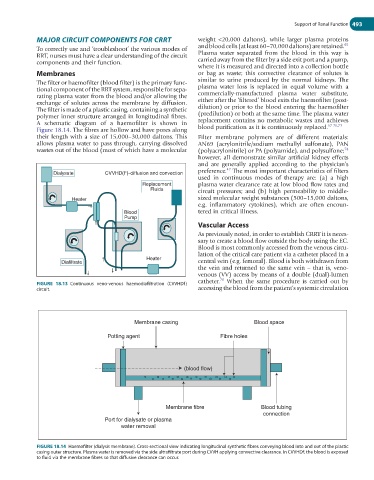
             The filter or haemofilter (blood filter) is the primary func-  similar  to  urine  produced  by  the  normal  kidneys.  The
             tional component of the RRT system, responsible for sepa-  plasma  water  loss  is  replaced  in  equal  volume  with  a
             rating plasma water from the blood and/or allowing the   commercially-manufactured  plasma  water  substitute,
             exchange of solutes across the membrane by diffusion.   either after the ‘filtered’ blood exits the haemofilter (post-
             The filter is made of a plastic casing, containing a synthetic   dilution) or prior to the blood entering the haemofilter
             polymer inner structure arranged in longitudinal fibres.   (predilution) or both at the same time. The plasma water
             A  schematic  diagram  of  a  haemofilter  is  shown  in    replacement contains no metabolic wastes and achieves
                                                                                                            67-70,73
             Figure 18.14. The fibres are hollow and have pores along   blood purification as it is continuously replaced.
             their length with a size of 15,000–30,000 daltons. This   Filter  membrane  polymers  are  of  different  materials:
             allows plasma water to pass through, carrying dissolved   AN69  (acrylonitrile/sodium  methallyl  sulfonate),  PAN
             wastes out of the blood (most of which have a molecular   (polyacrylonitrile) or PA (polyamide), and polysulfone;
                                                                                                                  74
                                                                  however, all demonstrate similar artificial kidney effects
                                                                  and  are  generally  applied  according  to  the  physician’s
                                                                           42
                   Dialysate       CVVHD(F)-diffusion and convection  preference.  The most important characteristics of filters
                                                                  used  in  continuous  modes  of  therapy  are:  (a)  a  high
                                                Replacement       plasma water clearance rate at low blood flow rates and
                                                  Fluids          circuit  pressures;  and  (b)  high  permeability  to  middle-
                         Heater                                   sized molecular weight substances (500–15,000 daltons,
                                                                  e.g.  inflammatory  cytokines),  which  are  often  encoun-
                                          Blood                   tered in critical illness.
                                          Pump
                                                                  Vascular Access
                                                                  As previously noted, in order to establish CRRT it is neces-
                                                                  sary to create a blood flow outside the body using the EC.
                                                                  Blood is most commonly accessed from the venous circu-
                                                                  lation of the critical care patient via a catheter placed in a
                                                 Heater
                     Diafiltrate                                  central vein (e.g. femoral). Blood is both withdrawn from
                                                                  the vein and returned to the same vein – that is, veno-
                                                                  venous (VV) access by means of a double (dual)-lumen
                                                                  catheter.   When  the  same  procedure  is  carried  out  by
                                                                         70
             FIGURE  18.13  Continuous  veno-venous  haemodiafiltration  (CVVHDf)
             circuit.                                             accessing the blood from the patient’s systemic circulation


                                             Membrane casing                        Blood space

                                    Potting agent                        Fibre holes


                                                             (blood flow)


                                                       Membrane fibre                 Blood tubing
                                                                                       connection
                                   Port for dialysate or plasma
                                         water removal


             FIGURE 18.14  Haemofilter (dialysis membrane). Cross-sectional view indicating longitudinal synthetic fibres conveying blood into and out of the plastic
             casing outer structure. Plasma water is removed via the side ultrafiltrate port during CVVH applying convective clearance. In CVVHDf, the blood is exposed
             to fluid via the membrane fibres so that diffusive clearance can occur.

