


Page 741 - ACCCN's Critical Care Nursing
P. 741
718  S P E C I A LT Y   P R A C T I C E   I N   C R I T I C A L   C A R E


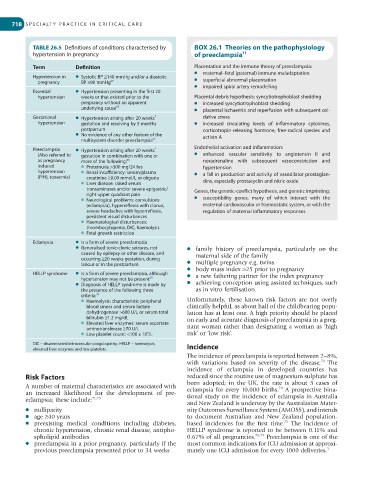
            TABLE 26.5  Definitions of conditions characterised by   BOX 26.1  Theories on the pathophysiology
            hypertension in pregnancy                            of preeclampsia 71

            Term          Definition                             Placentation and the immune theory of preeclampsia:
                                                                 l  maternal–fetal (paternal) immune maladaptation
            Hypertension in   l  Systolic BP ≥140 mmHg and/or a diastolic
             pregnancy      BP ≥90 mmHg 65                       l  superficial abnormal placentation
                                                                 l  impaired spiral artery remodelling
            Essential     l  Hypertension presenting in the first 20
             hypertension   weeks or that existed prior to the   Placental debris hypothesis: syncytiotrophoblast shedding
                            pregnancy without an apparent        l  increased syncytiotrophoblast shedding
                            underlying cause 65                  l  placental ischaemia and reperfusion with subsequent oxi-
            Gestational   l  Hypertension arising after 20 weeks’   dative stress
             hypertension   gestation and resolving by 3 months   l  increased  circulating  levels  of  inflammatory  cytokines,
                            postpartum                             corticotropin-releasing  hormone,  free-radical  species  and
                          l  No evidence of any other feature of the   activin A
                            multisystem disorder preeclampsia 65
            Preeclampsia   l  Hypertension arising after 20 weeks’   Endothelial activation and inflammation:
             (Also referred to   gestation in combination with one or   l  enhanced  vascular  sensitivity  to  angiotensin  II  and
             as pregnancy   more of the following: 65              noradrenaline  with  subsequent  vasoconstriction  and
             induced        l  Proteinuria >300 mg/24 hrs          hypertension
             hypertension   l  Renal insufficiency: serum/plasma   l  a fall in production and activity of vasodilator prostaglan-
             (PIH), toxaemia)  creatinine ≥0.09 mmol/L or oliguria
                            l  Liver disease: raised serum         dins, especially prostacyclin and nitric oxide
                             transaminases and/or severe epigastric/  Genes, the genetic-conflict hypothesis, and genetic imprinting:
                             right upper quadrant pain
                            l  Neurological problems: convulsions   l  susceptibility  genes,  many  of  which  interact  with  the
                             (eclampsia), hyperreflexia with clonus,   maternal cardiovascular or haemostatic system, or with the
                             severe headaches with hyperreflexia,   regulation of maternal inflammatory responses
                             persistent visual disturbances
                            l  Haematological disturbances:
                             thrombocytopenia, DIC, haemolysis
                            l  Fetal growth restriction
            Eclampsia     l  Is a form of severe preeclampsia
                          l  Generalised tonic-clonic seizures, not   l  family  history  of  preeclampsia,  particularly  on  the
                            caused by epilepsy or other disease, and   maternal side of the family
                            occurring ≥20 weeks gestation, during
                            labour or in the postpartum       l  multiple pregnancy e.g. twins
                                                              l  body mass index >25 prior to pregnancy
            HELLP syndrome  l  Is a form of severe preeclampsia, although   l  a new fathering partner for the index pregnancy
                            hypertension may not be present 69
                          l  Diagnosis of HELLP syndrome is made by   l  achieving conception using assisted techniques, such
                            the presence of the following three   as in vitro fertilisation.
                            criteria: 70
                            l  Haemolysis: characteristic peripheral   Unfortunately,  these  known  risk  factors  are  not  overly
                             blood smear and serum lactate    clinically helpful, as about half of the childbearing popu-
                             dehydrogenase >600 U/L or serum total   lation has at least one. A high priority should be placed
                             bilirubin ≥1.2 mg/dL             on early and accurate diagnosis of preeclampsia in a preg-
                            l  Elevated liver enzymes: serum aspartate
                             aminotransferase ≥70 U/L         nant woman rather than designating a woman as ‘high
                                                 9
                            l  Low platelet count: <100 x 10 /L  risk’ or ‘low risk’.
            DIC – disseminated intravascular coagulopathy; HELLP – haemolysis,   Incidence
            elevated liver enzymes and low platelets.
                                                              The incidence of preeclampsia is reported between 2–8%,
                                                                                                          73
                                                              with  variations  based  on  severity  of  the  disease.   The
                                                              incidence  of  eclampsia  in  developed  countries  has
         Risk Factors                                         reduced since the routine use of magnesium sulphate has
         A number of maternal characteristics are associated with   been  adopted;  in  the  UK,  the  rate  is  about  3  cases  of
                                                                                            74
         an  increased  likelihood  for  the  development  of  pre-  eclampsia for every 10,000 births.  A prospective bina-
         eclampsia; these include: 71,73                      tional study on the incidence of eclampsia in Australia
                                                              and New Zealand is underway by the Australasian Mater-
         l  nulliparity                                       nity Outcomes Surveillance System (AMOSS), and intends
         l  age ≥40 years                                     to  document  Australian  and  New  Zealand  population-
                                                                                              75
         l  preexisting  medical  conditions  including  diabetes,   based  incidences  for  the  first  time.   The  incidence  of
            chronic hypertension, chronic renal disease, antipho-  HELLP syndrome is reported to be between 0.11% and
            spholipid antibodies                              0.67% of all pregnancies. 76,77  Preeclampsia is one of the
         l  preeclampsia in a prior pregnancy, particularly if the   most common indications for ICU admission at approxi-
            previous preeclampsia presented prior to 34 weeks  mately one ICU admission for every 1000 deliveries. 3

