


Page 742 - ACCCN's Critical Care Nursing
P. 742
Pregnancy and Postpartum Considerations 719

             Clinical Presentation and Diagnosis                  specific sign of preeclampsia, though women who develop
             The clinical presentation of preeclampsia is often subtle,   non-dependent oedema, such as facial oedema, should
                                                                                                         66
             resulting in delayed diagnosis and treatment. Common   be investigated for evidence of preeclampsia.  Common
             symptoms  include  feeling  ‘generally  unwell’,  headache,   investigations  include  urea,  creatinine  and  electrolytes,
             heartburn, nausea and vomiting, and oedema; all non-  full blood examination, liver function tests, serum uric
             specific symptoms experienced by many pregnant women   acid,  spot  urine  protein/creatinine  ratio  and  24  hour
             who  do  not  have  preeclampsia.  Severe  preeclampsia  is   urine  collection.  Additional  tests,  such  as  coagulation
             associated with severe headache, hypereflexia, vision dis-  studies, may be required as indicated by the clinical con-
             turbances,  severe  epigastric  pain,  right  upper  quadrant   dition. Intra-uterine fetal growth restriction is a sign of
             pain  and  even  blindness.  There  is  also  evidence  of   placental  involvement  (i.e.  impairment)  and  investiga-
             impaired  systolic  and  diastolic  myocardial  function.   tion  into  fetal  wellbeing,  including  an  ultrasound  for
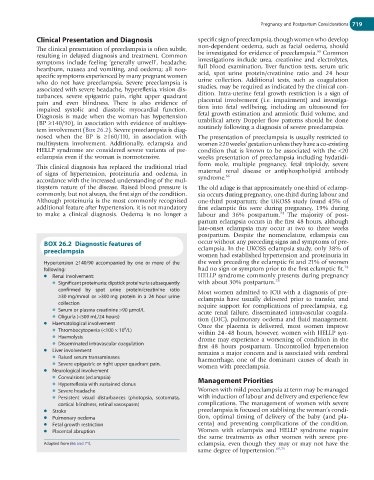
             Diagnosis  is  made  when  the  woman  has  hypertension   fetal growth estimation and amniotic fluid volume, and
             (BP ≥140/90), in association with evidence of multisys-  umbilical artery Doppler flow patterns should be done
             tem involvement (Box 26.2). Severe preeclampsia is diag-  routinely following a diagnosis of severe preeclampsia.
             nosed  when  the  BP  is  ≥160/110,  in  association  with   The presentation of preeclampsia is usually restricted to
             multisystem  involvement.  Additionally,  eclampsia  and   women ≥20 weeks’ gestation unless they have a co-existing
             HELLP syndrome are considered severe variants of pre-  condition  that  is  known  to  be  associated  with  the  <20
             eclampsia even if the woman is normotensive.         weeks  presentation  of  preeclampsia  including  hydatidi-
                                                                  form  mole,  multiple  pregnancy,  fetal  triploidy,  severe
             This clinical diagnosis has replaced the traditional triad
             of  signs  of  hypertension,  proteinuria  and  oedema,  in   maternal  renal  disease  or  antiphospholipid  antibody
                                                                           66
             accordance with the increased understanding of the mul-  syndrome.
             tisystem nature of the disease. Raised blood pressure is   The old adage is that approximately one-third of eclamp-
             commonly, but not always, the first sign of the condition.   sia occurs during pregnancy, one-third during labour and
             Although proteinuria is the most commonly recognised   one-third postpartum; the UKOSS study found 45% of
             additional feature after hypertension, it is not mandatory   first  eclamptic  fits  were  during  pregnancy,  19%  during
             to  make  a  clinical  diagnosis.  Oedema  is  no  longer  a   labour  and  36%  postpartum.   The  majority  of  post-
                                                                                             74
                                                                  partum eclampsia occurs in the first 48 hours, although
                                                                  late-onset  eclampsia  may  occur  at  two  to  three  weeks
                                                                  postpartum.  Despite  the  nomenclature,  eclampsia  can
               BOX 26.2  Diagnostic features of                   occur without any preceding signs and symptoms of pre-
               preeclampsia                                       eclampsia. In the UKOSS eclampsia study, only 38% of
                                                                  women had established hypertension and proteinuria in
               Hypertension  ≥140/90  accompanied  by  one  or  more  of  the   the week preceding the eclamptic fit and 21% of women
                                                                                                                  74
               following:                                         had no sign or symptom prior to the first eclamptic fit.
               l  Renal involvement:                              HELLP syndrome commonly presents during pregnancy
                  l  Significant proteinuria: dipstick proteinuria subsequently   with about 30% postpartum. 78
                    confirmed  by  spot  urine  protein/creatinine  ratio     Most women admitted to ICU with a diagnosis of pre-
                    ≥30 mg/mmol  or  >300 mg  protein  in  a  24  hour  urine   eclampsia  have  usually  delivered  prior  to  transfer,  and
                    collection                                    require  support  for  complications  of  preeclampsia,  e.g.
                  l  Serum or plasma creatinine >90 µmol/L        acute  renal  failure,  disseminated  intravascular  coagula-
                  l  Oliguria (<500 mL/24 hours)                  tion (DIC), pulmonary oedema and fluid management.
               l  Haematological involvement                      Once  the  placenta  is  delivered,  most  women  improve
                                          9
                  l  Thrombocytopenia (<100 × 10 /L)              within 24–48 hours, however, women with HELLP syn-
                  l  Haemolysis                                   drome may experience a worsening of condition in the
                  l  Disseminated intravascular coagulation       first  48  hours  postpartum.  Uncontrolled  hypertension
               l  Liver involvement                               remains a major concern and is associated with cerebral
                  l  Raised serum transaminases                   haemorrhage,  one  of  the  dominant  causes  of  death  in
                  l  Severe epigastric or right upper quadrant pain.  women with preeclampsia.
               l  Neurological involvement
                  l  Convulsions (eclampsia)                      Management Priorities
                  l  Hyperreflexia with sustained clonus
                  l  Severe headache                              Women with mild preeclampsia at term may be managed
                  l  Persistent  visual  disturbances  (photopsia,  scotomata,   with induction of labour and delivery and experience few
                    cortical blindness, retinal vasospasm)        complications. The management of women with severe
               l  Stroke                                          preeclampsia is focused on stablising the woman’s condi-
               l  Pulmonary oedema                                tion,  optimal  timing  of  delivery  of  the  baby  (and  pla-
               l  Fetal growth restriction                        centa)  and  preventing  complications  of  the  condition.
               l  Placental abruption                             Women  with  eclampsia  and  HELLP  syndrome  require
                                                                  the  same  treatments  as  other  women  with  severe  pre-
               Adapted from (66 and 71).                          eclampsia, even though they may or may not have the
                                                                  same degree of hypertension. 69,79

