Page 95 - Concise Pathology for Exam Preparation ( PDFDrive )
P. 95
80    SECTION I    General Pathology


                                                Fibrin­rich  thrombus
                              Lysosomal enzymes   
                                from   leukocytes                   Organization
                                        Central         Gradual  ingrowth  of granulation   
                                       softening         tissue, subendothelial smooth   
                                                         muscle   cells   and   mesenchymal 
                                                        cells   into   the   fibrin­rich  thrombus
                                       Secondary 
                                    bacterial  infection
                                                         Formation of capillary  channels   
                                                            within  the   thrombus
                                      Septic   emboli
                                                     Surface  of the  thrombus  gets  covered with 
                                                    endothelial cells and capillary channels begin 
                                                                           another
                                                      to  anastomose  from one  end to
                                                     Re­establishment of continuity of the  lumen 
                                                              (recanalization)

                                                  Thrombus converts into      a  vascularized  subendothelial   
                                                           mass of connective   tissue

                                                     Eventual incorporation into   the   wall  of vessel

                                                            mesenchymal
                                                                         that  a
                                                 Contraction of     cells so     fibrous lump 
                                                       or   thickening  remains to mark the site
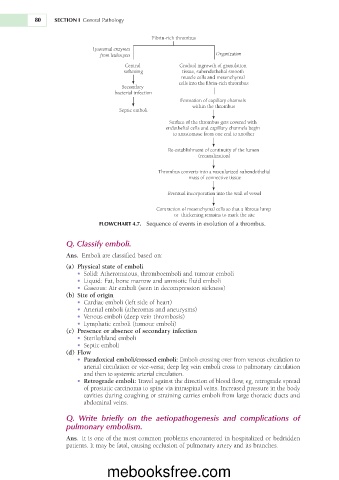
                                FLOWCHART 4.7.    Sequence of events in evolution of a thrombus.
                     Q.   Classify emboli.
                     Ans.    Emboli   are   classified   based   on:
                     (a)
                         Physical state of emboli
                            •	�Solid:   Atheromatous,   thromboemboli   and   tumour   emboli
                            •	�Liquid:   Fat,   bone   marrow   and   amniotic   fluid   emboli
                            •	�Gaseous:   Air   emboli   (seen     decompression   sickness)
                                                in
                       (b)  Site of origin

                            •	�Cardiac   emboli   (left   side     heart)
                                               of
                            •	�Arterial   emboli   (atheromas   and   aneurysms)
                            •	�Venous   emboli   (deep   vein   thrombosis)
                            •	�Lymphatic   emboli   (tumour   emboli)
                         Presence or absence of secondary infection
                     (c)
                            •	�Sterile/bland   emboli
                            •	�Septic   emboli
                     (d)   Flow
                                                                                            t
                                                         

                                                                                            o

                            •	�Paradoxical emboli/crossed emboli: Emboli  crossing   over  from   venous   circulation    
                           arterial   circulation     vice-versa;  deep   leg   vein   emboli   cross     pulmonary   circulation   
                                                                          t
                                         o
                                                                           o
                                          r
                                  t
                                   o
                           and  then    systemic   arterial   circulation.
                            •	�Retrograde emboli: Travel   against   the   direction     blood   flow,   eg,   retrograde   spread   
                                            
                                                                 of
                           of   prostatic   carcinoma     spine   via   intraspinal   veins.   Increased   pressure     the   body   
                                                                                    in
                                             to
                                               or
                           cavities   during   coughing     straining   carries   emboli   from   large   thoracic   ducts   and   
                           abdominal   veins.
                     Q.    Write  briefly  on  the  aetiopathogenesis  and  complications  of
                     pulmonary embolism.
                                                                      in
                     Ans.       one     the   most   common   problems   encountered     hospitalized     bedridden   
                                                                                   or
                            is
                          It
                                  of
                                                                             its
                                                        of
                             It
                                   be
                     patients.     may     fatal,   causing   occlusion     pulmonary   artery  and     branches.
                                  mebooksfree.com
   90   91   92   93   94   95   96   97   98   99   100