


Page 271 - Concise Pathology for Exam Preparation ( PDFDrive )
P. 271
256    SECTION II  Diseases of Organ Systems


                        Clinical	syndromes	associated	with	IHD	are
                       1.  Myocardial infarction (MI)
                       2.  Angina pectoris:
                         (a)  Stable
                         (b)  Prinzmetal or variant
                         (c)  Unstable or crescendo
                       3.  Chronic ischaemic heart disease with heart failure
                       4.  Sudden cardiac death
                        These clinical syndromes are a result of a complex dynamic interaction between
                     •	 Fixed atherosclerotic narrowing
                     •	 Intraluminal thrombosis overlying a disrupted atherosclerotic plaque
                     •	 Platelet aggregation and vasospasm
                     Q.  Write  briefly  on  the  role  of  fixed  coronary  obstruction  in  the
                     pathogenesis of IHD.
                     Ans. Ninety percent patients with IHD have underlying atherosclerosis with presence of
                     solitary or multiple lesions, causing at	least	75%	reduction	of	cross-sectional	area	of	at
                     least	one	major	artery.
                     •	 Common locations for clinically significant stenosis include the first several cm of LAD
                       (left anterior descending artery) and LCX (left circumflex artery), and the entire length
                       of RCA (right coronary artery).
                     •	 Usually 2 or all 3 arteries (LAD, LCX and RCA) are involved.
                     •	 Major secondary epicardial branches may also be involved but atherosclerosis of intra-
                       mural branches is rare.
                     Q. Write briefly on the role of acute plaque change in the pathogenesis
                     of IHD.
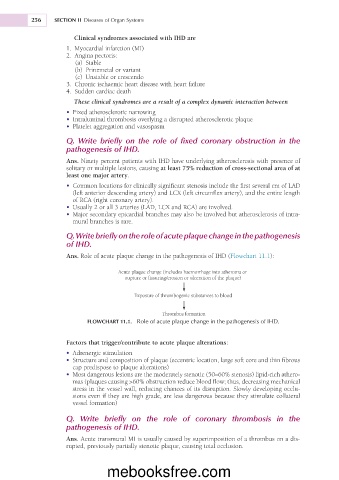
                     Ans. Role of acute plaque change in the pathogenesis of IHD (Flowchart 11.1):


                                     Acute plaque change (includes haemorrhage into atheroma or
                                        rupture or fissuring/erosion or ulceration of the plaque)

                                          Exposure of thrombogenic substances to blood


                                                   Thrombus formation
                            FLOWCHART 11.1.  Role of acute plaque change in the pathogenesis of IHD.


                     Factors	that	trigger/contribute	to	acute	plaque	alterations:
                     •	 Adrenergic stimulation
                     •	 Structure and composition of plaque (eccentric location, large soft core and thin fibrous
                       cap predispose to plaque alterations)
                     •	 Most dangerous lesions are the moderately stenotic (50–60% stenosis) lipid-rich athero-
                       mas (plaques causing >60% obstruction reduce blood flow; thus, decreasing mechanical
                       stress in the vessel wall, reducing chances of its disruption. Slowly developing occlu-
                       sions even if they are high grade, are less dangerous because they stimulate collateral
                       vessel formation)

                     Q.  Write  briefly  on  the  role  of  coronary  thrombosis  in  the
                     pathogenesis of IHD.

                     Ans. Acute transmural MI is usually caused by superimposition of a thrombus on a dis-
                     rupted, previously partially stenotic plaque, causing total occlusion.


                                  mebooksfree.com

