


Page 273 - Concise Pathology for Exam Preparation ( PDFDrive )
P. 273
258    SECTION II  Diseases of Organ Systems


                       2.  Prinzmetal	variant	angina
                         (a)  Uncommon pattern of episodic angina that occurs at rest and is due to coronary
                           artery spasm
                         (b)  Attacks unrelated to physical activity, heart rate or blood pressure
                         (c)  Elevation of ST segment (indicative of transmural ischaemia) is typically seen
                          (d)  Responds promptly to vasodilators like nitroglycerin and calcium channel blockers
                       3.  Unstable/crescendo	angina
                         (a)  Repeated episodes of pain with progressively increasing (crescendo) frequency
                         (b)  Often occurs at rest and tends to be of prolonged duration
                         (c)  Induced  by  disruption  of  an  atherosclerotic  plaque  with  superimposed  partial
                           thrombosis and embolization/vasospasm or both
                          (d)  Precedes acute MI in many patients (also called preinfarction angina)

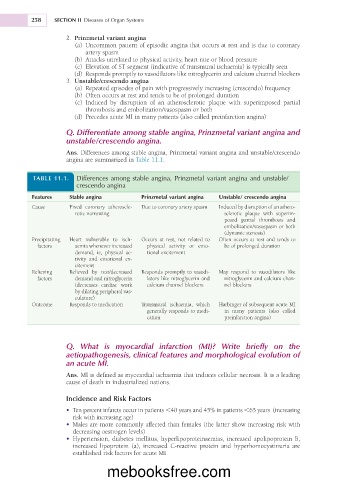
                     Q. Differentiate among stable angina, Prinzmetal variant angina and
                     unstable/crescendo angina.

                     Ans. Differences among stable angina, Prinzmetal variant angina and unstable/crescendo
                     angina are summarized in Table 11.1.


           TABLE 11.1.     Differences among stable angina, Prinzmetal variant angina and unstable/
                         crescendo angina
           Features   Stable angina          Prinzmetal variant angina  Unstable/ crescendo angina
           Cause      Fixed  coronary  atheroscle-  Due to coronary artery spasm  Induced by disruption of an athero-
                        rotic narrowing                               sclerotic  plaque  with  superim-
                                                                      posed  partial  thrombosis  and
                                                                      embolization/vasospasm or both
                                                                      (dynamic stenosis)
           Precipitating   Heart  vulnerable  to  isch-  Occurs  at  rest,  not  related  to   Often occurs at rest and tends to
             factors    aemia whenever increased   physical  activity  or  emo-  be of prolonged duration
                        demand,  ie,  physical  ac-  tional excitement
                        tivity  and  emotional  ex-
                        citement
           Relieving   Relieved  by  rest/decreased   Responds promptly to vasodi-  May  respond  to  vasodilators  like
             factors    demand and nitroglycerin   lators like nitroglycerin and   nitroglycerin and calcium chan-
                        (decreases  cardiac  work   calcium channel blockers  nel blockers
                        by dilating peripheral vas-
                        culature)
           Outcome    Responds to medication  Transmural  ischaemia,  which    Harbinger of subsequent acute MI
                                              generally responds to medi-  in  many  patients  (also  called
                                              cation                  preinfarction angina)


                     Q.  What  is  myocardial  infarction  (MI)?  Write  briefly  on  the
                     aetiopathogenesis, clinical features and morphological evolution of
                     an acute MI.
                     Ans. MI is defined as myocardial ischaemia that induces cellular necrosis. It is a leading
                     cause of death in industrialized nations.

                     Incidence and Risk Factors
                     •	 Ten percent infarcts occur in patients ,40 years and 45% in patients ,65 years  (increasing
                       risk with increasing age)
                     •	 Males are more commonly affected than females (the latter show increasing risk with
                       decreasing oestrogen levels)
                     •	 Hypertension, diabetes mellitus, hyperlipoproteinaemias, increased apolipoprotein B,
                       increased  lipoprotein  (a),  increased  C-reactive  protein  and  hyperhomocystinuria  are
                       established risk factors for acute MI


                                  mebooksfree.com

