


Page 275 - Concise Pathology for Exam Preparation ( PDFDrive )
P. 275
260    SECTION II  Diseases of Organ Systems


                     •	 Morphological events
                       •	 ATP depletion leads to loss of contractility within a few minutes.
                       •	 A state of irreversible injury sets in within 20–40 min.
                       •	 Microvascular injury begins within 1 h.
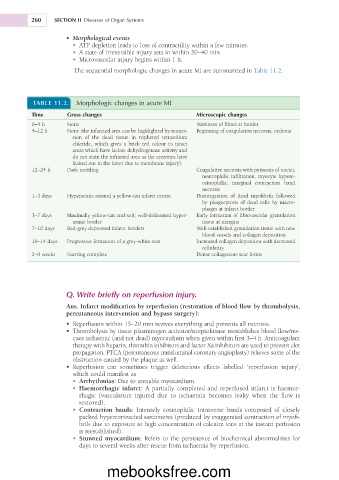
                        The sequential morphologic changes in acute MI are summarized in Table 11.2.


           TABLE 11.2.   Morphologic changes in acute MI
           Time       Gross changes                           Microscopic changes
           0–4 h      None                                    Waviness of fibres at border
           4–12 h     None (the infarcted area can be highlighted by immer-  Beginning of coagulation necrosis, oedema
                       sion  of  the  dead  tissue  in  triphenyl  tetrazolium
                       chloride,  which  gives  a  brick  red  colour  to  intact
                       areas which have lactate dehydrogenase activity and
                       do not stain the infracted area as the enzymes have
                       leaked out in the latter due to membrane injury).
           12–24 h    Dark mottling                           Coagulative necrosis with pyknosis of nuclei;
                                                               neutrophilic infiltration, myocyte hypere-
                                                               osinophilia;  marginal  contraction  band
                                                               necrosis
           1–3 days   Hyperaemia around a yellow-tan infarct centre  Disintegration  of  dead  myofibrils  followed
                                                               by  phagocytosis  of  dead  cells  by  macro-
                                                               phages at infarct border
           3–7 days   Maximally yellow-tan and soft; well-delineated hyper-  Early formation of fibrovascular granulation
                       aemic border                            tissue at margins
           7–10 days  Red-grey depressed infarct borders      Well-established granulation tissue with new
                                                               blood vessels and collagen deposition
           10–14 days  Progressive formation of a grey-white scar  Increased collagen deposition with decreased
                                                               cellularity
           2–8 weeks  Scarring complete                       Dense collagenous scar forms


                     Q. Write briefly on reperfusion injury.
                     Ans.	Infarct	modification	by	reperfusion	(restoration	of	blood	flow	by	thrombolysis,
                     percutaneous	intervention	and	bypass	surgery):
                     •	 Reperfusion within 15–20 min revives everything and prevents all necrosis.
                     •	 Thrombolysis by tissue plasminogen activator/streptokinase reestablishes blood flow/res-
                       cues ischaemic (and not dead) myocardium when given within first 3–4 h. Anticoagulant
                       therapy with heparin, thrombin inhibitors and factor Xa inhibitors are used to prevent clot
                       propagation. PTCA (percutaneous transluminal coronary angioplasty) relieves some of the
                       obstruction caused by the plaque as well.
                     •	 Reperfusion  can  sometimes  trigger  deleterious  effects  labelled  ‘reperfusion  injury’,
                       which could manifest as
                       •	 Arrhythmias: Due to unstable myocardium.
                       •	 Haemorrhagic	infarct: A partially completed and reperfused infarct is haemor-
                         rhagic  (vasculature  injured  due  to  ischaemia  becomes  leaky  when  the  flow  is
                         restored).
                       •	 Contraction	 bands:  Intensely  eosinophilic  transverse  bands  composed  of  closely
                         packed hypercontracted sarcomeres (produced by exaggerated contraction of myofi-
                         brils due to exposure to high concentration of calcium ions at the instant perfusion
                         is reestablished).
                       •	 Stunned	 myocardium:  Refers  to  the  persistence  of  biochemical  abnormalities  for
                         days to several weeks after rescue from ischaemia by reperfusion.


                                  mebooksfree.com

