


Page 276 - Concise Pathology for Exam Preparation ( PDFDrive )
P. 276
11  Disorders of the Heart  261


             Q. Enumerate the types of myocardial infarcts. Differentiate between
             transmural and subendocardial infarcts.

             Ans. Depending on the thickness of the myocardium involved, myocardial infarcts are
             classified into:
               1.  Transmural infarcts: Involve the whole thickness of the ventricular wall in the distribu-
                tion of a single coronary artery
               2.  Subendocardial infarcts: Involve only the inner one-third to one-half of the ventricular
                thickness
               3.  Multifocal microinfarcts: Multifocal microinfarction is seen when small intramural ves-
                sels are involved by vasculitis, microembolization or vasospasm.
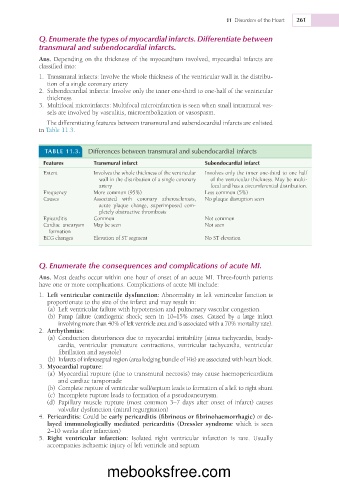
               The differentiating features between transmural and subendocardial infarcts are enlisted
             in Table 11.3.


               TABLE 11.3.  Differences between transmural and subendocardial infarcts

              Features        Transmural infarct                Subendocardial infarct
              Extent          Involves the whole thickness of the ventricular   Involves only the inner one-third to one half
                                wall in the distribution of a single coronary   of the ventricular thickness. May be multi-
                                artery                            focal and has a circumferential distribution.
              Frequency       More common (95%)                 Less common (5%)
              Causes          Associated  with  coronary  atherosclerosis,   No plaque disruption seen
                                acute  plaque  change,  superimposed  com-
                                pletely obstructive thrombosis
              Epicarditis     Common                            Not common
              Cardiac  aneurysm   May be seen                   Not seen
                formation
              ECG changes     Elevation of ST segment           No ST elevation


             Q. Enumerate the consequences and complications of acute MI.

             Ans. Most deaths occur within one hour of onset of an acute MI. Three-fourth patients
             have one or more complications. Complications of acute MI include:
               1.  Left	ventricular	contractile	dysfunction:	Abnormality in left ventricular function is
                proportionate to the size of the infarct and may result in:
                 (a)  Left ventricular failure with hypotension and pulmonary vascular congestion.
                 (b)  Pump  failure  (cardiogenic  shock;  seen  in  10–15%  cases.  Caused  by  a  large  infarct
                   involving more than 40% of left ventricle area and is associated with a 70% mortality rate).
               2.  Arrhythmias:
                 (a)  Conduction disturbances due to myocardial irritability (sinus tachycardia, brady-
                   cardia,  ventricular  premature  contractions,  ventricular  tachycardia,  ventricular
                   fibrillation and asystole)
                 (b)  Infarcts of inferoseptal region (area lodging bundle of His) are associated with heart block.
               3.  Myocardial	rupture:
                 (a)  Myocardial rupture (due to transmural necrosis) may cause haemopericardium
                   and cardiac tamponade
                 (b)  Complete rupture of ventricular wall/septum leads to formation of a left to right shunt
                 (c)  Incomplete rupture leads to formation of a pseudoaneurysm.
                  (d)  Papillary muscle rupture (most common 3–7 days after onset of infarct) causes
                   valvular dysfunction (mitral regurgitation)
               4.  Pericarditis:	Could be early	pericarditis	(fibrinous	or	fibrinohaemorrhagic) or de-
                layed  immunologically	 mediated	 pericarditis  (Dressler	 syndrome  which  is  seen
                2–10 weeks after infarction)
               5.  Right	 ventricular	 infarction:  Isolated  right  ventricular  infarction  is  rare.  Usually
                accompanies ischaemic injury of left ventricle and septum


                                  mebooksfree.com

