


Page 274 - Concise Pathology for Exam Preparation ( PDFDrive )
P. 274
11  Disorders of the Heart  259

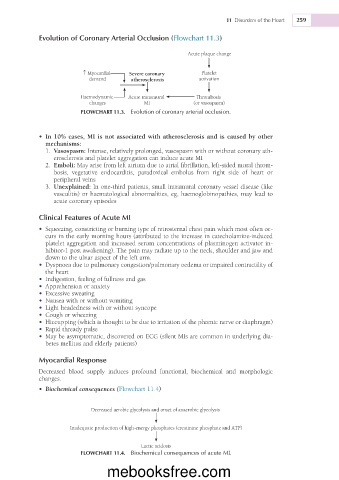
             Evolution of Coronary Arterial Occlusion (Flowchart 11.3)


                                                           Acute plaque change


                           ↑ Myocardial   Severe coronary      Platelet
                            demand       atherosclerosis      activation

                          Haemodynamic   Acute transmural    Thrombosis
                             changes         MI              (or vasospasm)
                          FLOWCHART 11.3.  Evolution of coronary arterial occlusion.


             •	 In	10%	cases,	MI	is	not	associated	with	atherosclerosis	and	is	caused	by	other
               mechanisms:
                1.  Vasospasm: Intense, relatively prolonged, vasospasm with or without coronary ath-
                  erosclerosis and platelet aggregation can induce acute MI
                2.  Emboli: May arise from left atrium due to atrial fibrillation, left-sided mural throm-
                  bosis,  vegetative  endocarditis,  paradoxical  embolus  from  right  side  of  heart  or
                  peripheral veins
                3.  Unexplained: In one-third patients, small intramural coronary vessel disease (like
                  vasculitis) or haematological abnormalities, eg, haemoglobinopathies, may lead to
                  acute coronary episodes

             Clinical Features of Acute MI
             •	 Squeezing, constricting or burning type of retrosternal chest pain which most often oc-
               curs in the early morning hours (attributed to the increase in catecholamine-induced
               platelet aggregation and increased serum concentrations of plasminogen activator in-
               hibitor-1 post awakening). The pain may radiate up to the neck, shoulder and jaw and
               down to the ulnar aspect of the left arm.
             •	 Dyspnoea due to pulmonary congestion/pulmonary oedema or impaired contractility of
               the heart
             •	 Indigestion, feeling of fullness and gas
             •	 Apprehension or anxiety
             •	 Excessive sweating
             •	 Nausea with or without vomiting
             •	 Light headedness with or without syncope
             •	 Cough or wheezing
             •	 Hiccupping (which is thought to be due to irritation of the phrenic nerve or diaphragm)
             •	 Rapid thready pulse
             •	 May be asymptomatic, discovered on ECG (silent MIs are common in underlying dia-
               betes mellitus and elderly patients)

             Myocardial Response

             Decreased  blood  supply  induces  profound  functional,  biochemical  and  morphologic
             changes.
             •	 Biochemical consequences (Flowchart 11.4)


                             Decreased aerobic glycolysis and onset of anaerobic glycolysis


                       Inadequate production of high-energy phosphates (creatinine phosphate and ATP)

                                            Lactic acidosis
                          FLOWCHART 11.4.  Biochemical consequences of acute MI.


                                  mebooksfree.com

