


Page 280 - Concise Pathology for Exam Preparation ( PDFDrive )
P. 280
11  Disorders of the Heart  265


                   (i)	 ASD
                      -  Abnormal opening in the atrial septum that allows communication of blood
                        between left and right atria
                      -  Well tolerated and asymptomatic till adulthood
                      -  Murmur develops due to excessive blood flow through pulmonary valve
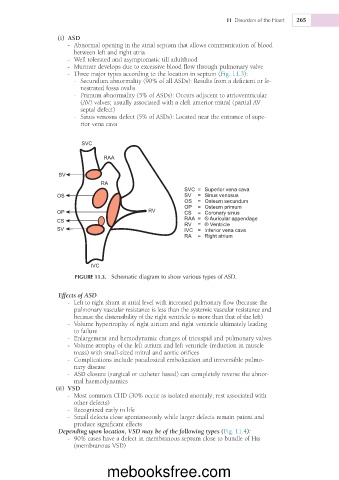
                      -  Three major types according to the location in septum (Fig. 11.3):
                        -  Secundum abnormality (90% of all ASDs): Results from a deficient or fe-
                          nestrated fossa ovalis
                        -  Primum abnormality (5% of ASDs): Occurs adjacent to atrioventricular
                          (AV) valves; usually associated with a cleft anterior mitral (partial AV
                          septal defect)
                        -  Sinus venosus defect (5% of ASDs): Located near the entrance of supe-
                          rior vena cava


                          SVC

                                 RAA

                   SV
                                RA
                                                          SVC = Superior vena cava
                   OS                                     SV  = Sinus venosus
                                                          OS  = Osteum secundum
                                                          OP  = Osteum primum
                   OP                          RV         CS  = Coronary sinus
                   CS                                     RAA = ® Auricular appendage
                                                          RV  = ®  Ventricle
                   SV                                     IVC = Inferior vena cava
                                                          RA  = Right atrium


                             IVC
                        FIGURE 11.3.  Schematic diagram to show various types of ASD.


                   Effects of ASD
                      -  Left to right shunt at atrial level with increased pulmonary flow (because the
                        pulmonary vascular resistance is less than the systemic vascular resistance and
                        because the distensibility of the right ventricle is more than that of the left)
                      -  Volume hypertrophy of right atrium and right ventricle ultimately leading
                        to failure
                      -  Enlargement and hemodynamic changes of tricuspid and pulmonary valves
                      -  Volume atrophy of the left atrium and left ventricle (reduction in muscle
                        mass) with small-sized mitral and aortic orifices
                      -  Complications include paradoxical embolization and irreversible pulmo-
                        nary disease
                      -  ASD closure (surgical or catheter based) can completely reverse the abnor-
                        mal haemodynamics
                 	 (ii)	 VSD
                      -  Most common CHD (30% occur as isolated anomaly; rest associated with
                        other defects)
                      -  Recognized early in life
                      -  Small defects close spontaneously while larger defects remain patent and
                        produce significant effects
                   Depending upon location, VSD may be of the following types (Fig. 11.4):
                      -  90% cases have a defect in membranous septum close to bundle of His
                        (membranous VSD)


                                  mebooksfree.com

