


Page 279 - Concise Pathology for Exam Preparation ( PDFDrive )
P. 279
264    SECTION II  Diseases of Organ Systems

                     Genetic Factors

                     •	 Single gene mutations (genes encoding transcription factors required for normal cardiac
                       development, eg, GATA4, Tbx5 and genes encoding components of Notch pathway)
                     •	 Small chromosomal deletions, eg, deletion of chromosome 22q11.2 in DiGeorge syn-
                       drome, which leads to abnormal development of 4th bronchial arch and derivatives of
                       3rd and 4th pharyngeal pouches responsible for the development of heart.
                     •	 Additions and deletions of whole chromosomes, eg, trisomy of chromosomes13, 15, 18
                       and 21, and Turner syndrome

                     Maternal risks
                     Rubella, alcohol and drugs (teratogens)

                     Q.  Classify  congenital  heart  disease.  Write  briefly  on  the
                     clinicopathological features of the various types of CHD.
                     Ans.	Classification and clinicopathological features of various types of CHD:
                       1.  Malpositions	of	the	heart	(dextrocardia)
                         (a)  Apex of the heart points to the right of the chest.
                         (b)  May be accompanied by situs inversus; so, heart remains in normal position with
                           respect to the other organs.
                         (c)  Isolated dextrocardia may be associated with major anomalies, eg, transposition of
                           aorta and transposition of great vessels.
                       2.  Shunts:	Abnormal communication between chambers or blood vessels
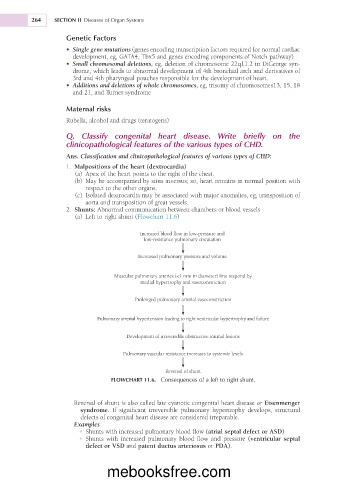
                         (a)  Left to right shunt (Flowchart 11.6)

                                            Increased blood flow in low-pressure and
                                             low-resistance pulmonary circulation

                                            Increased pulmonary pressure and volume

                                    Muscular pulmonary arteries (<1 mm in diameter) first respond by
                                            medial hypertrophy and vasoconstriction

                                           Prolonged pulmonary arterial vasoconstriction


                               Pulmonary arterial hypertension leading to right ventricular hypertrophy and failure

                                        Development of irreversible obstructive intimal lesions

                                       Pulmonary vascular resistance increases to systemic levels


                                                    Reversal of shunt
                                   FLOWCHART 11.6.  Consequences of a left to right shunt.


                        Reversal of shunt is also called late cyanotic congenital heart disease or Eisenmenger
                          syndrome.	 If  significant  irreversible  pulmonary  hypertrophy  develops,  structural
                          defects of congenital heart disease are considered irreparable.
                        Examples
                         •	 Shunts with increased pulmonary blood flow (atrial	septal	defect	or	ASD)
                         •	 Shunts  with  increased  pulmonary  blood  flow  and  pressure  (ventricular	 septal
                           defect	or	VSD and patent	ductus	arteriosus	or	PDA).


                                  mebooksfree.com

