


Page 277 - Concise Pathology for Exam Preparation ( PDFDrive )
P. 277
262    SECTION II  Diseases of Organ Systems


                       6.  Infarct	extension/expansion: New necrosis/weakening and disproportionate stretch-
                         ing, thinning or dilatation of infarct, leads to its extension/expansion
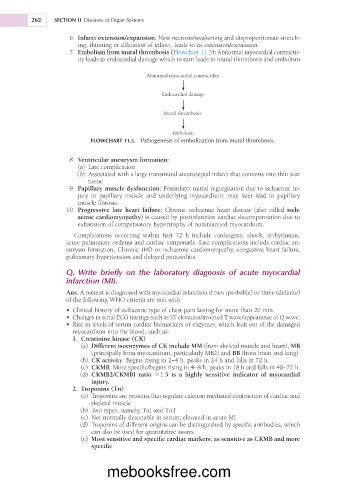
                       7.  Embolism	from	mural	thrombosis	(Flowchart 11.5): Abnormal myocardial contractil-
                         ity leads to endocardial damage which in turn leads to mural thrombosis and embolism

                                              Abnormal myocardial contractility


                                                   Endocardial damage

                                                   Mural thrombosis


                                                      Embolism
                             FLOWCHART 11.5.  Pathogenesis of embolization from mural thrombosis.

                       8.  Ventricular	aneurysm	formation:
                         (a)  Late complication
                         (b)  Associated with a large transmural anteroseptal infarct that converts into thin scar
                            tissue
                       9.  Papillary	muscle	dysfunction: Postinfarct mitral regurgitation due to ischaemic in-
                         jury  to  papillary  muscle  and  underlying  myocardium;  may  later  lead  to  papillary
                         muscle fibrosis.
                       10.  Progressive	 late	 heart	 failure:	 Chronic  ischaemic  heart  disease  (also  called  isch-
                         aemic cardiomyopathy) is caused by postinfarction cardiac decompensation due to
                         exhaustion of compensatory hypertrophy of noninfarcted myocardium.
                        Complications  occurring  within  first  72  h  include  cardiogenic  shock,  arrhythmias,
                     acute pulmonary oedema and cardiac tamponade. Late complications include cardiac an-
                     eurysm formation, Chronic IHD or ischaemic cardiomyopathy, congestive heart failure,
                     pulmonary hypertension and delayed pericarditis.

                     Q.  Write  briefly  on  the  laboratory  diagnosis  of  acute  myocardial
                     infarction (MI).

                     Ans. A patient is diagnosed with myocardial infarction if two (probable) or three (definite)
                     of the following WHO criteria are met with:
                     •	 Clinical history of ischaemic type of chest pain lasting for more than 20 min.
                     •	 Changes in serial ECG tracings such as ST elevation/inverted T wave/appearance of Q wave.
                     •	 Rise in levels of serum cardiac biomarkers or enzymes, which leak out of the damaged
                       myocardium into the blood, such as:
                      	 1.	 Creatinine	kinase	(CK)
                           (a)  Different	isoenzymes	of	CK	include	MM (from skeletal muscle and heart), MB
                             (principally from myocardium, particularly MB2) and BB (from brain and lung).
                           (b)  CK	activity: Begins rising in 2–4 h, peaks in 24 h and falls in 72 h.
                           (c)  CKMB: More specific/begins rising in 4–8 h, peaks in 18 h and falls in 48–72 h.
                           (d)  CKMB2/CKMBI	 ratio	 .1.5	 is	 a	 highly	 sensitive	 indicator	 of	 myocardial
                             injury.
                      	 2.	 Troponins	(Tn)
                           (a)  Troponins are proteins that regulate calcium mediated contraction of cardiac and
                             skeletal muscle.
                           (b)  Two types, namely, TnI and TnT
                           (c)  Not normally detectable in serum; elevated in acute MI
                           (d)  Troponins of different origins can be distinguished by specific antibodies, which
                             can also be used for quantitative assays
                           (e)  Most	sensitive	and	specific	cardiac	markers;	as	sensitive	as	CKMB	and	more
                             specific


                                  mebooksfree.com

