


Page 302 - Concise Pathology for Exam Preparation ( PDFDrive )
P. 302
12  Haematology  287

             Q.  Discuss  the  aetiology,  classification  and  clinical  features  of
             anaemia.
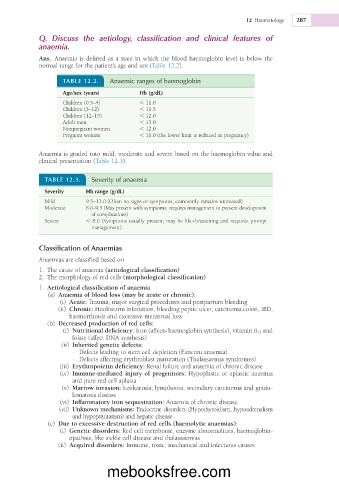
             Ans.  Anaemia is defined as a state in which the blood haemoglobin level is below the
             normal range for the patient’s age and sex (Table 12.2).

                    TABLE 12.2.    Anaemic ranges of haemoglobin
                    Age/sex (years)         Hb (g/dL)
                    Children (0.5–4)        , 11.0
                    Children (5–12)         , 11.5
                    Children (12–15)        , 12.0
                    Adult men               , 13.0
                    Nonpregnant women       , 12.0
                    Pregnant women          , 11.0 (the lower limit is reduced in pregnancy)


             Anaemia is graded into mild, moderate and severe based on the haemoglobin value and
             clinical presentation (Table 12.3).


               TABLE 12.3.   Severity of anaemia
               Severity    Hb range (g/dL)
               Mild        9.5–13.0 (Often no signs or symptoms; commonly remains untreated)
               Moderate    8.0–9.5 (May present with symptoms; requires management to prevent development
                             of complications)
               Severe      , 8.0 (Symptoms usually present; may be life-threatening and requires prompt
                             management)


             Classification of Anaemias
             Anaemias are classified based on
               1.  The cause of anaemia (aetiological classification)
               2.  The morphology of red cells (morphological classification)
               1.  Aetiol ogical classification of anaemia
                 (a)  Anaemia of blood loss (may be acute or chronic):
                    (i)  Acute: Trauma, major surgical procedures and postpartum bleeding
                     (ii)  Chronic: Hookworm infestation, bleeding peptic ulcer, carcinoma colon, IBD,
                      haemorrhoids and excessive menstrual loss
                 (b)  Decreased production of red cells:
                    (i)  Nutritional deficiency: Iron (affects haemoglobin synthesis), vitamin B 12  and
                       folate (affect DNA synthesis)
                    (ii)  Inherited genetic defects:
                       -  Defects leading to stem cell depletion (Fanconi anaemia)
                       -  Defects affecting erythroblast maturation (Thalassaemia syndromes)
                   (iii)  Erythropoietin deficiency: Renal failure and anaemia of chronic disease
                   (iv)  Immune-mediated injury of progenitors: Hypoplastic or aplastic anaemia
                       and pure red cell aplasia
                    (v)  Marrow invasion: Leukaemia, lymphoma, secondary carcinoma and granu-
                       lomatous disease
                   (vi)  Inflammatory iron sequestration: Anaemia of chronic disease.
                   (vii)  Unknown mechanisms: Endocrine disorders (Hypothyroidism, hypoadrenalism
                       and hypopituitarism) and hepatic disease
                 (c)  Due to excessive destruction of red cells (haemolytic anaemias):
                    (i)  Genetic disorders: Red cell membrane, enzyme abnormalities, haemoglobin-
                      opathies, like sickle cell disease and thalassaemias
                     (ii)  Acquired disorders: Immune, toxic, mechanical and infectious causes


                                  mebooksfree.com

