


Page 306 - Concise Pathology for Exam Preparation ( PDFDrive )
P. 306
12  Haematology  291

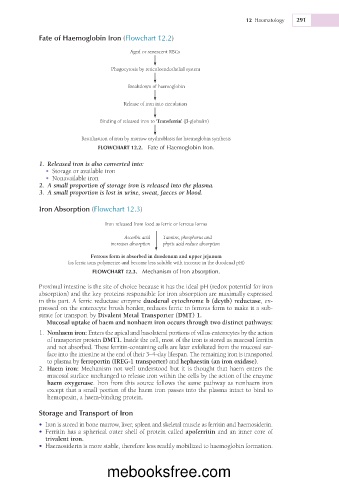
             Fate of Haemoglobin Iron (Flowchart 12.2)

                                         Aged or senescent RBCs


                                   Phagocytosis by reticuloendothelial system

                                        Breakdown of haemoglobin

                                       Release of iron into circulation


                                Binding of released iron to ‘Transferrin’ (β-globulin)

                          Reutilization of iron by marrow erythroblasts for haemoglobin synthesis
                               FLOWCHART 12.2.  Fate of Haemoglobin Iron.

             	1.	 Released	iron	is	also	converted	into:
               •  Storage or available iron
               •  Nonavailable iron
             	2.	 A	small	proportion	of	storage	iron	is	released	into	the	plasma.
             	3.	 A	small	proportion	is	lost	in	urine,	sweat,	faeces	or	blood.

             Iron Absorption (Flowchart 12.3)

                                 Iron released from food as ferric or ferrous forms

                                       Ascorbic acid  Tannins, phosphorus and
                                   increases absorption  phytic acid reduce absorption

                             Ferrous form is absorbed in duodenum and upper jejunum
                      (as ferric ions polymerize and become less soluble with increase in the duodenal pH)
                             FLOWCHART 12.3.  Mechanism of Iron absorption.
             Proximal intestine is the site of choice because it has the ideal pH (redox potential for iron
             absorption) and the key proteins responsible for iron absorption are maximally expressed
             in this part. A ferric reductase enzyme duodenal cytochrome b (dcytb) reductase, ex-
             pressed on the enterocyte brush border, reduces ferric to ferrous form to make it a sub-
             strate for transport by Divalent Metal Transporter (DMT) 1.
               Mucosal uptake of haem and nonhaem iron occurs through two distinct pathways:
              1.  Nonhaem iron: Enters the apical and basolateral portions of villus enterocytes by the action
                of transporter protein DMT1. Inside the cell, most of the iron is stored as mucosal ferritin
                and not absorbed. These ferritin-containing cells are later exfoliated from the mucosal sur-
                face into the intestine at the end of their 3–4-day lifespan. The remaining iron is transported
                to plasma by ferroportin (IREG-1 transporter) and hephaestin (an iron oxidase).
               2.  Haem iron: Mechanism not well understood but it is thought that haem enters the
                mucosal surface unchanged to release iron within the cells by the action of the enzyme
                haem oxygenase. Iron from this source follows the same pathway as nonhaem iron
                except that a small portion of the haem iron passes into the plasma intact to bind to
                hemopexin, a haem-binding protein.
             Storage and Transport of Iron

             •  Iron is stored in bone marrow, liver, spleen and skeletal muscle as ferritin and haemosiderin.
             •  Ferritin has a spherical outer shell of protein called apoferritin and an inner core of
               trivalent iron.
             •  Haemosiderin is more stable, therefore less readily mobilized to haemoglobin formation.


                                  mebooksfree.com

