


Page 304 - Concise Pathology for Exam Preparation ( PDFDrive )
P. 304
12  Haematology  289


               TABLE 12.4.   Morphological abnormalities of red cells in different types of anaemias—cont’d

               Abnormalities    Description                                      Morphology
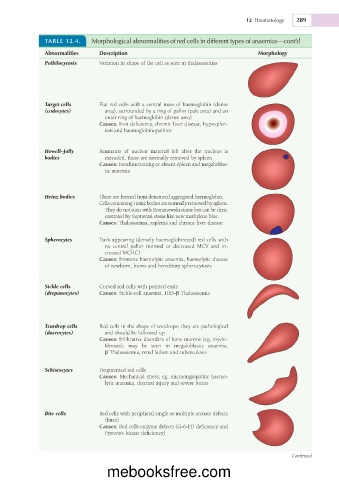
               Poikilocytosis   Variation in shape of the cell as seen in thalassaemias


               Target cells     Flat red cells with a central mass of haemoglobin (dense
               (codocytes)       area), surrounded by a ring of pallor (pale area) and an
                                 outer ring of haemoglobin (dense area)
                                Causes: Iron deficiency, chronic liver disease, hyposplen-
                                 ism and haemoglobinopathies


               Howell–Jolly     Remnants  of  nuclear  material  left  after  the  nucleus  is
               bodies            extruded, these are normally removed by spleen
                                Causes: Nonfunctioning or absent spleen and megaloblas-
                                 tic anaemia


               Heinz bodies     These are formed from denatured aggregated haemoglobin.
                                Cells containing Heinz bodies are normally removed by spleen.
                                 They do not stain with Romanowski stains but can be dem-
                                 onstrated by Supravital stains like new methylene blue.
                                Causes: Thalassaemia, asplenia and chronic liver disease


               Spherocytes      Dark appearing (densely haemoglobinized) red cells with
                                 no  central  pallor  (normal  or  decreased  MCV  and  in-
                                 creased MCHC)
                                Causes: Immune haemolytic anaemia, haemolytic disease
                                 of newborn, burns and hereditary spherocytosis


               Sickle cells     Curved red cells with pointed ends
               (drepanocytes)   Causes: Sickle-cell anaemia, HbS-b Thalassaemia


               Teardrop cells   Red cells in the shape of teardrops; they are pathological
               (dacrocytes)      and should be followed up
                                Causes: Infiltrative disorders of bone marrow (eg, myelo-
                                 fibrosis);  may  be  seen  in  megaloblastic  anaemia,
                                 b Thalassaemia, renal failure and tuberculosis

               Schistocytes     Fragmented red cells
                                Causes: Mechanical stress, eg, microangiopathic haemo-
                                 lytic anaemia, thermal injury and severe burns


               Bite cells       Red cells with peripheral single or multiple arcuate defects
                                 (bites)
                                Causes: Red cells enzyme defects (G-6-PD deficiency and
                                 Pyruvate kinase deficiency)


                                                                                           Continued

                                  mebooksfree.com

