


Page 310 - Concise Pathology for Exam Preparation ( PDFDrive )
P. 310
12  Haematology  295


             Characteristic Features
             •  Affects middle-aged to elderly individuals who present with insidious onset moderate
               to severe anaemia.
             •  The peripheral smear shows a dimorphic picture with microcytic, hypochromic and
               normocytic cells.
             •  Iron overload with characteristic ringed sideroblasts are seen in the bone marrow (iron
               enters mitochondria surrounding the nucleus, cannot exit and appears as ‘rings’ with
               Prussian blue staining).
             •  Siderocytes called Pappenheimer bodies (containing nonhaem iron granules) are seen
               in the RBCs.
             •  Bone marrow shows erythroid hyperplasia and ineffective erythropoiesis. Dyserythro-
               poiesis is common.
             •  There is marked increase in serum iron and transferrin saturation.

             Q. Enumerate the causes of microcytic hypochromic anaemia.

             Ans.  Causes	of	microcytic	hypochromic	anaemia	include
             •  Iron-deficiency anaemia
             •  Thalassaemia syndromes
             •  Sideroblastic anaemia
             •  Chronic lead poisoning
             •  Some cases of anaemia associated with chronic disorders


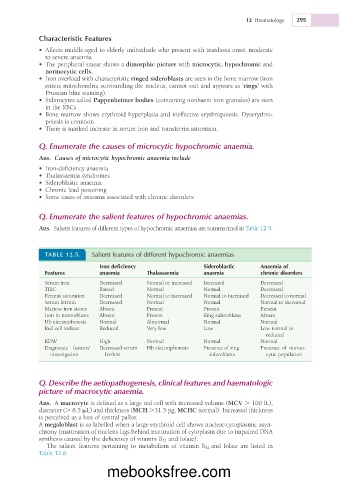
             Q. Enumerate the salient features of hypochromic anaemias.
             Ans.  Salient features of different types of hypochromic anaemias are summarized in Table 12.5.


               TABLE 12.5.   Salient features of different hypochromic anaemias
                                Iron deficiency                 Sideroblastic    Anaemia of
               Features         anaemia       Thalassaemia      anaemia          chronic disorders
               Serum iron       Decreased     Normal or increased  Increased     Decreased
               TIBC             Raised        Normal            Normal           Decreased
               Percent saturation   Decreased  Normal to increased  Normal to increased  Decreased to normal
               Serum ferritin   Decreased     Normal            Normal           Normal to increased
               Marrow iron stores  Absent     Present           Present          Present
               Iron in normoblasts  Absent    Present           Ring sideroblasts  Absent
               Hb electrophoresis  Normal     Abnormal          Normal           Normal
               Red cell indices  Reduced      Very low          Low              Low normal to
                                                                                   reduced
               RDW              High          Normal            Normal           Normal
               Diagnostic  feature/   Decreased serum   Hb electrophoresis  Presence of ring    Presence  of  normo-
                 investigation   ferritin                        sideroblasts      cytic population


             Q. Describe the aetiopathogenesis, clinical features and haematologic
             picture of macrocytic anaemia.

             Ans.  A macrocyte is defined as a large red cell with increased volume (MCV . 100 fL),
             diameter (. 8.5 mL) and thickness (MCH .31.5 pg; MCHC normal). Increased thickness
             is perceived as a loss of central pallor.
             A megaloblast is so labelled when a large erythroid cell shows nuclear-cytoplasmic asyn-
             chrony (maturation of nucleus lags behind maturation of cytoplasm due to impaired DNA
             synthesis caused by the deficiency of vitamin B 12  and folate).
               The  salient  features  pertaining  to  metabolism  of  vitamin  B 12  and  folate  are  listed  in
             Table 12.6.


                                  mebooksfree.com

