


Page 308 - Concise Pathology for Exam Preparation ( PDFDrive )
P. 308
12  Haematology  293


               •  Tongue: Atrophy of papillae, shiny or glazed tongue, glossitis and angular stomatitis
               •  Plummer–Vinson  (Paterson–Kelly)  syndrome:  Characterized  by  chronic  iron  defi-
                 ciency,  dysphagia  and  glossitis;  seen  in  middle-aged  to  elderly  women  who  have
                 chronic iron deficiency and a fine web or band composed of desquamating epithelial
                 cells at the oesophageal entrance (postcricoid web). These patients present with dys-
                 phagia to solids.
             •  Pica: This is defined as a craving to eat substances like dirt, clay, salt, hair and is a
               typical manifestation of iron deficiency.
             •  Recurrent infections: Iron deficiency induces defective lymphocyte-mediated immu-
               nity and impairs bacterial killing by phagocytes leading to impaired immunity and re-
               current infections.

             Laboratory Diagnosis

               1.  General blood parameters
                 (a)  Hb: Decreased
                 (b)  RBC count: Decreased
                 (c)  RBC indices: Reduced/low
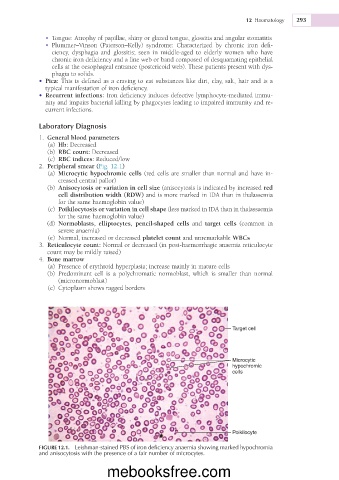
               2.  Peripheral smear (Fig. 12.1)
                 (a)  Microcytic hypochromic cells (red cells are smaller than normal and have in-
                   creased central pallor)
                 (b)  Anisocytosis or variation in cell size (anisocytosis is indicated by increased red
                   cell distribution width (RDW) and is more marked in IDA than in thalassemia
                   for the same haemoglobin value)
                 (c)  Poikilocytosis or variation in cell shape (less marked in IDA than in thalassaemia
                   for the same haemoglobin value)
                  (d)  Normoblasts,  elliptocytes,  pencil-shaped  cells  and  target  cells  (common  in
                   severe anaemia)
                 (e)  Normal, increased or decreased platelet count and unremarkable WBCs
               3.  Reticulocyte count: Normal or decreased (in post-haemorrhagic anaemia reticulocyte
                count may be mildly raised)
               4.  Bone marrow
                 (a)  Presence of erythroid hyperplasia; increase mainly in mature cells
                 (b)  Predominant  cell  is  a  polychromatic  normoblast,  which  is  smaller  than  normal
                   (micronormoblast)
                 (c)  Cytoplasm shows ragged borders


                                                                         Target cell


                                                                         Microcytic
                                                                         hypochromic
                                                                         cells


                                                                         Poikilocyte

             FIGURE 12.1.  Leishman-stained PBS of iron deficiency anaemia showing marked hypochromia
             and anisocytosis with the presence of a fair number of microcytes.


                                  mebooksfree.com

