


Page 311 - Concise Pathology for Exam Preparation ( PDFDrive )
P. 311
296    SECTION II  Diseases of Organ Systems


                     TABLE 12.6.    Salient  features  pertaining  to  the  metabolism
                                    of vitamin B 12  and folate
                     Features              B 12                 Folate
                     Content in food       Vegetables: poor source  Vegetables: rich source
                                           Meat: rich source    Meat: moderate source
                                           Milk: good source    Milk: poor source
                     Effect of cooking     10–30% loss          60–90% loss
                     Adult: daily requirement  2–4 mcg          200 mcg
                     Adult: daily intake   5–30 mcg             100–500 mcg
                     Site of absorption    Ileum                Duodenum and jejunum
                     Body stores           2–5 mg               5–20 mg
                                           Adequate for 3 years  Adequate for 4 months


                     Vitamin B 12
                       1.  Dietary	sources	of	vitamin	B 12 : B 12  is predominantly present in animal products (meat,
                        muscle, fish, eggs, cheese and milk); therefore, pure vegetarians may suffer from defi-
                        ciency. B 12  is synthesized by bacteria in nature. In humans, these bacteria are normal
                        inhabitants of large bowel but B 12  cannot be absorbed from this site and thus humans
                        are entirely dependent on dietary sources.
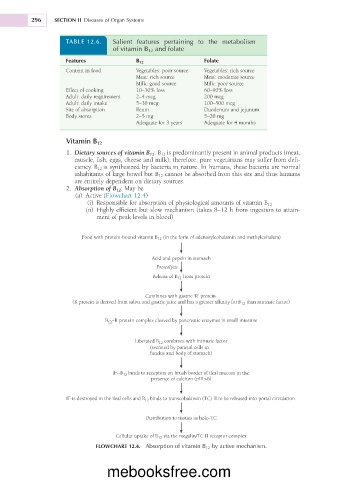
                       2.  Absorption	of	B 12 : May be
                         (a)  Active (Flowchart 12.4)
                            (i)  Responsible for absorption of physiological amounts of vitamin B 12
                             (ii)  Highly efficient but slow mechanism (takes 8–12 h from ingestion to attain-
                               ment of peak levels in blood)


                          Food with protein-bound vitamin B  (in the form of adenosylcobalamin and methylcobalam)
                                                  12

                                                Acid and pepsin in stomach
                                                 Proteolysis
                                                          from protein
                                                Release of B 12

                                              Combines with gastric ‘R’ protein
                       (R protein is derived from saliva and gastric juice and has a greater affinity for B 12  than intrinsic factor)

                                 B –R protein complex cleaved by pancreatic enzymes in small intestine
                                  12

                                           Liberated B  combines with intrinsic factor
                                                  12
                                               (secreted by parietal cells in
                                               fundus and body of stomach)

                                    IF--B 12  binds to receptors on brush border of ileal mucosa in the
                                                presence of calcium (pH >6)


                     IF is destroyed in the ileal cells and B 12  binds to transcobalamin (TC) II to be released into portal circulation


                                              Distribution to tissues as holo-TC


                                     Cellular uptake of B 12  via the megalin/TC II receptor complex
                              FLOWCHART 12.4.  Absorption of vitamin B 12  by active mechanism.


                                  mebooksfree.com

