


Page 35 - Concise Pathology for Exam Preparation ( PDFDrive )
P. 35
20    SECTION I  General Pathology


                                           Binding of Fas L to Fas (receptor–ligand interactions)


                                           Three or more molecules of Fas are brought together


                               The cytoplasmic domain of three Fas molecules forms a binding site for an adapter protein
                                                FADD (Fas-associated death domain)


                                                 FADD binds inactive Caspase-8


                                          Activation of Caspase-8 and initiation of caspase cascade
                                                FLOWCHART 1.11.  cont’d


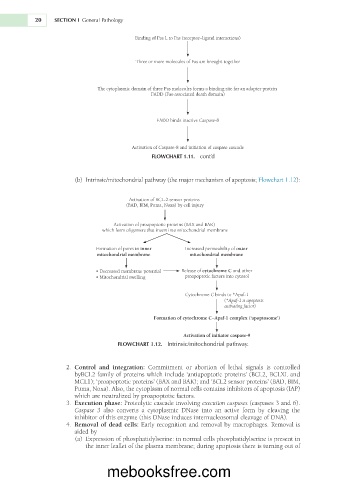
                         (b)  Intrinsic/mitochondrial pathway (the major mechanism of apoptosis; Flowchart 1.12):


                                         Activation of BCL-2 sensor proteins
                                        (BAD, BIM, Puma, Noxa) by cell injury


                                    Activation of proapoptotic proteins (BAX and BAK)
                                which form oligomers that insert into mitochondrial membrane

                               Formation of pores in inner   Increased permeability of outer
                               mitochondrial membrane      mitochondrial membrane


                               • Decreased membrane potential  Release of cytochrome C and other
                               • Mitochondrial swelling   proapoptotic factors into cytosol

                                                          Cytochrome C binds to *Apaf-1
                                                                      (*Apaf-1 is apoptosis
                                                                      activating factor)

                                                Formation of cytochrome C–Apaf-1 complex (‘apoptosome’)

                                                         Activation of initiator caspase-9
                                     FLOWCHART 1.12.  Intrinsic/mitochondrial pathway.


                       2.  Control  and  integration:  Commitment  or  abortion  of  lethal  signals  is  controlled
                        byBCL2 family of proteins which include ‘antiapoptotic proteins’ (BCL2, BCLXL and
                        MCL1); ‘proapoptotic proteins’ (BAX and BAK); and ‘BCL2 sensor proteins’ (BAD, BIM,
                        Puma, Noxa). Also, the cytoplasm of normal cells contains inhibitors of apoptosis (IAP)
                        which are neutralized by proapoptotic factors.
                       3.  Execution phase: Proteolytic cascade involving execution caspases (caspases 3 and 6).
                        Caspase  3  also  converts  a  cytoplasmic  DNase  into  an  active  form  by  cleaving  the
                        inhibitor of this enzyme (this DNase induces internucleosomal cleavage of DNA).
                       4.  Removal of dead cells: Early recognition and removal by macrophages. Removal is
                        aided by
                         (a)  Expression of phosphatidylserine: in normal cells phosphatidylserine is present in
                           the inner leaflet of the plasma membrane; during apoptosis there is turning out of


                                  mebooksfree.com

