


Page 414 - Concise Pathology for Exam Preparation ( PDFDrive )
P. 414
14  The Oral Cavity and Gastrointestinal Tract  399


             •	 Increases  production  of  proinflammatory  cytokines,  eg,  IL-1,  IL-6,  TNF  and  IL-8
               (chemotactic to neutrophils).
             •	 May cause thrombotic occlusion causing ischaemia.
             •	 Epithelial injury is induced by VacA (a vacuolating toxin) regulated by CagA (cytotoxin-
               associated gene).
               H. pylori is	associated	with	duodenal	ulcer	in	80–90%	patients	and	gastric	ulcer
             in	60%	patients. Virulence of the infecting strain determines development of peptic ulcer
             in an individual infected with H. pylori.

             Gross Morphology
             •	 Small, round-to-oval, sharply punched-out ulcers, varying in size between 2 and 4 cm.
             •	 Straight wall, mucosa may overhang the base.
             •	 Base—clean and smooth (due to peptic digestion)

             Microscopic Features
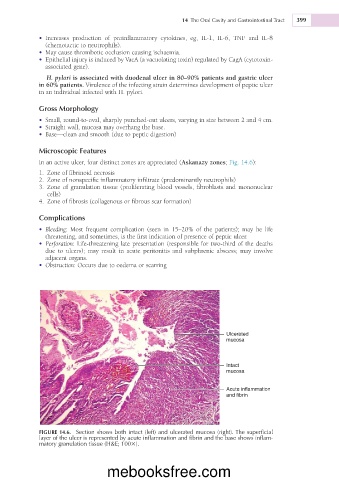
             In an active ulcer, four distinct zones are appreciated (Askanazy	zones; Fig. 14.6):
               1.  Zone of fibrinoid necrosis
               2.  Zone of nonspecific inflammatory infiltrate (predominantly neutrophils)
               3.  Zone of granulation tissue (proliferating blood vessels, fibroblasts and mononuclear
                cells)
               4.  Zone of fibrosis (collagenous or fibrous scar formation)

             Complications
             •	 Bleeding:  Most  frequent  complication  (seen  in  15–20%  of  the  patients);  may  be  life
               threatening, and sometimes, is the first indication of presence of peptic ulcer.
             •	 Perforation: Life-threatening late presentation (responsible for two-third of the deaths
               due  to  ulcers);  may  result  in  acute  peritonitis  and  subphrenic  abscess;  may  involve
               adjacent organs.
             •	 Obstruction: Occurs due to oedema or scarring


                                                                       Ulcerated
                                                                       mucosa


                                                                       Intact
                                                                       mucosa

                                                                       Acute inflammation
                                                                       and fibrin


             FIGURE 14.6.  Section shows both intact (left) and ulcerated mucosa (right). The superficial
             layer of the ulcer is represented by acute inflammation and fibrin and the base shows inflam-
             matory granulation tissue (H&E; 1003).


                                  mebooksfree.com

