


Page 415 - Concise Pathology for Exam Preparation ( PDFDrive )
P. 415
400
           400    SECTION II  Diseases of Organ Systems
                     Q. Write briefly on hypertrophic gastropathies.

                     Ans. Hypertrophic gastropathies include
                       1.  Zollinger–Ellison	(ZE)	syndrome:
                        •	 This syndrome presents with hypergastrinaemia due to a gastrinoma (gastrin-producing
                          tumour); usual age of presentation is between 50 and 60 years. The gastrinoma is most
                          frequently found in the duodenum and peripancreatic soft tissues and originates from
                          endocrine cells of both gut and pancreas.
                        •	 Gastrin  induces  hyperplasia  of  mucous  neck  cells  (causing  diarrhoea),  endocrine
                          cells and oxyntic mucosa (causing hypergastrinaemia which in turn induces hyper-
                          secretion of gastric acid causing ulcers in the usual sites like stomach and duodenum
                          and also in unusual sites like jejunum).
                        •	 Treatment is surgical resection of the tumour.
                       2.  Menetrier	disease:
                        •	 Patient  aged  30–60  years  presents  with  hypoproteinaemia,  weight  loss  and
                          diarrhoea.
                        •	 There is cerebriform enlargement or hypertrophy of the rugal folds due to epithelial
                          hyperplasia which mainly affects mucous cells in the body and fundus. This is attrib-
                          uted to increased TGF-alfa.
                        •	 Dilated tortuous glands may be seen.
                        •	 Treatment is supportive only (parenteral nutritional supplementation).

                     Q. Differentiate between duodenal and gastric ulcer.
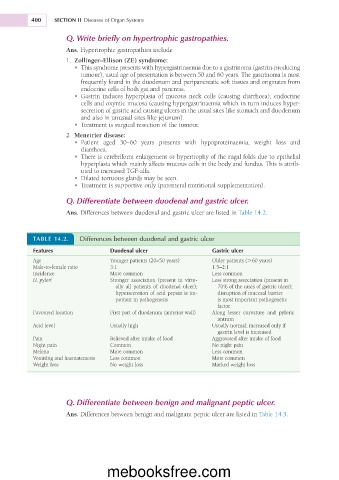
                     Ans.	Differences between duodenal and gastric ulcer are listed in Table 14.2.


           TABLE 14.2.    Differences between duodenal and gastric ulcer

           Features                Duodenal ulcer                 Gastric ulcer
           Age                     Younger patients (20–50 years)  Older patients (.60 years)
           Male-to-female ratio    3:1                            1.5–2:1
           Incidence               More common                    Less common
           H. pylori               Stronger  association  (present  in  virtu-  Less strong association (present in
                                     ally  all  patients  of  duodenal  ulcer);   70% of the cases of gastric ulcer);
                                     hypersecretion of acid pepsin is im-  disruption of mucosal barrier
                                     portant in pathogenesis        is most important pathogenetic
                                                                    factor
           Favoured location       First part of duodenum (anterior wall)  Along  lesser  curvature  and  pyloric
                                                                    antrum
           Acid level              Usually high                   Usually normal; increased only if
                                                                    gastrin level is increased
           Pain                    Relieved after intake of food  Aggravated after intake of food
           Night pain              Common                         No night pain
           Melena                  More common                    Less common
           Vomiting and haematemesis  Less common                 More common
           Weight loss             No weight loss                 Marked weight loss


                     Q. Differentiate between benign and malignant peptic ulcer.

                     Ans. Differences between benign and malignant peptic ulcer are listed in Table 14.3.


                                  mebooksfree.com

