


Page 488 - Concise Pathology for Exam Preparation ( PDFDrive )
P. 488
16  Diseases of the Kidney and Lower Urinary Tract  473


                                                                       Thickened
                                                                       basement
                                                                       membrane


                                                                       Hypercellular
                                                                       glomerular
                                                                       Accentuation of
                                                                       lobulation


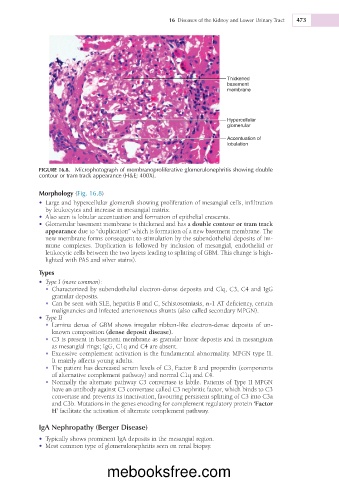
             FIGURE 16.8.  Microphotograph of membranoproliferative glomerulonephritis showing double
             contour or tram track appearance (H&E; 400X).

             Morphology (Fig. 16.8)
             •  Large and hypercellular glomeruli showing proliferation of mesangial cells, infiltration
               by leukocytes and increase in mesangial matrix.
             •  Also seen is lobular accentuation and formation of epithelial crescents.
             •  Glomerular basement membrane is thickened and has a double contour or tram track
               appearance due to “duplication” which is formation of a new basement membrane. The
               new membrane forms consequent to stimulation by the subendothelial deposits of im-
               mune  complexes.  Duplication  is  followed  by  inclusion  of  mesangial,  endothelial  or
               leukocytic cells between the two layers leading to splitting of GBM. This change is high-
               lighted with PAS and silver stains).

             Types
             •  Type I (more common):
               •  Characterized by subendothelial electron-dense deposits and Clq, C3, C4 and IgG
                 granular deposits.
               •  Can be seen with SLE, hepatitis B and C, Schistosomiasis, a-1 AT deficiency, certain
                 malignancies and infected arteriovenous shunts (also called secondary MPGN).
             •  Type II
               •  Lamina  densa  of  GBM  shows  irregular  ribbon-like  electron-dense  deposits  of  un-
                 known composition (dense deposit disease).
               •  C3 is present in basement membrane as granular linear deposits and in mesangium
                 as mesangial rings; IgG, C1q and C4 are absent.
               •  Excessive complement activation is the fundamental abnormality. MPGN type II.
                 It mainly affects young adults.
               •  The patient has decreased serum levels of C3, Factor B and properdin (components
                 of alternative complement pathway) and normal C1q and C4.
               •  Normally the alternate pathway C3 convertase is labile. Patients of Type II MPGN
                 have an antibody against C3 convertase called C3 nephritic factor, which binds to C3
                 convertase and prevents its inactivation, favouring persistent splitting of C3 into C3a
                 and C3b. Mutations in the genes encoding for complement regulatory protein ‘Factor
                 H’ facilitate the activation of alternate complement pathway.

             IgA Nephropathy (Berger Disease)

             •  Typically shows prominent IgA deposits in the mesangial region.
             •  Most common type of glomerulonephritis seen on renal biopsy.


                                  mebooksfree.com

