


Page 493 - Concise Pathology for Exam Preparation ( PDFDrive )
P. 493
478    SECTION II  Diseases of Organ Systems

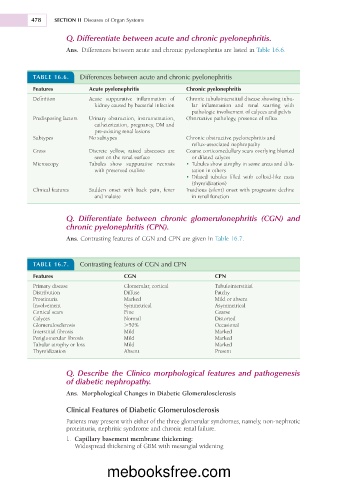
                     Q. Differentiate between acute and chronic pyelonephritis.

                     Ans.  Differences between acute and chronic pyelonephritis are listed in Table 16.6.


           TABLE 16.6.    Differences between acute and chronic pyelonephritis
           Features         Acute pyelonephritis          Chronic pyelonephritis
           Definition       Acute  suppurative  inflammation  of   Chronic tubulointerstitial disease showing tubu-
                              kidney caused by bacterial infection  lar  inflammation  and  renal  scarring  with
                                                            pathologic involvement of calyces and pelvis
           Predisposing factors  Urinary  obstruction,  instrumentation,   Obstructive pathology, presence of reflux
                              catheterization, pregnancy, DM and
                              pre-existing renal lesions
           Subtypes         No subtypes                   Chronic obstructive pyelonephritis and
                                                            reflux-associated nephropathy
           Gross            Discrete  yellow,  raised  abscesses  are   Coarse corticomedullary scars overlying blunted
                              seen on the renal surface     or dilated calyces
           Microscopy       Tubules  show  suppurative  necrosis   •  Tubules show atrophy in some areas and dila-
                              with preserved outline        tation in others
                                                          •  Dilated  tubules  filled  with  colloid-like  casts
                                                            (thyroidization)
           Clinical features  Sudden  onset  with  back  pain,  fever   Insidious (silent) onset with progressive decline
                              and malaise                   in renal function


                     Q.  Differentiate  between  chronic  glomerulonephritis  (CGN)  and
                     chronic pyelonephritis (CPN).
                     Ans. Contrasting features of CGN and CPN are given in Table 16.7.


           TABLE 16.7.    Contrasting features of CGN and CPN
           Features                    CGN                         CPN
           Primary disease             Glomerular, cortical        Tubulointerstitial
           Distribution                Diffuse                     Patchy
           Proteinuria                 Marked                      Mild or absent
           Involvement                 Symmetrical                 Asymmetrical
           Cortical scars              Fine                        Coarse
           Calyces                     Normal                      Distorted
           Glomerulosclerosis          .50%                        Occasional
           Interstitial fibrosis       Mild                        Marked
           Periglomerular fibrosis     Mild                        Marked
           Tubular atrophy or loss     Mild                        Marked
           Thyroidization              Absent                      Present


                     Q. Describe the Clinico morphological features and pathogenesis
                     of diabetic nephropathy.

                     Ans.  Morphological Changes in Diabetic Glomerulosclerosis

                     Clinical Features of Diabetic Glomerulosclerosis
                     Patients may present with either of the three glomerular syndromes, namely, non-nephrotic
                     proteinuria, nephritic syndrome and chronic renal failure.
                       1.  Capillary basement membrane thickening:
                        Widespread thickening of GBM with mesangial widening


                                  mebooksfree.com

