


Page 557 - Concise Pathology for Exam Preparation ( PDFDrive )
P. 557
542    SECTION II  Diseases of Organ Systems


                       •	 Flattened follicular epithelium with abundant colloid results in an enlarged, colloid
                         rich gland (colloid	goitre).
                     Clinical features
                     •	 Patients are usually clinically euthyroid
                     •	 Main symptoms are due to mass effects
                       2.  Multinodular	goitre	(MNG)
                     •	 Repeated episodes of hyperplasia and involution lead to irregular enlargement of thyroid
                       with formation of nodules.
                     •	 MNG may be nontoxic or toxic depending on the secretion of T 3  and T 4 .
                     •	 Normal thyroid cells are heterogeneous with respect to response to TSH and ability to
                       replicate. Thyroid cells with high-intrinsic growth potential replicate actively.
                     Steps in the evolution of MNG are given in (Flowchart 20.6):

                                       Thyroid cells with high-intrinsic growth potential
                                            Active replication  Mutations in TSH signalling pathways
                                                Autonomous growth

                                       Formation of polyclonal and monoclonal nodules


                                    Uneven follicular hyperplasia and accumulation of colloid

                                                Tensions and stresses


                                             Rupture of follicles and vessels

                                          Haemorrhage, scarring and calcification
                                    FLOWCHART 20.6.  Evolution of a multinodular goitre.

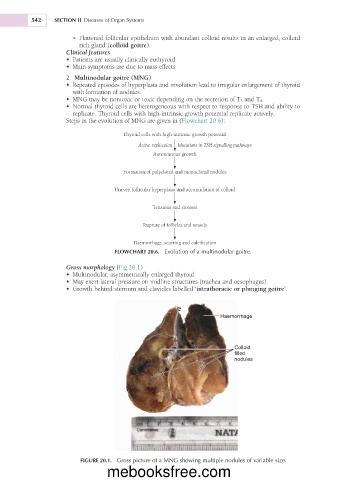
                     Gross morphology (Fig 20.1)
                     •	 Multinodular, asymmetrically enlarged thyroid
                     •	 May exert lateral pressure on midline structures (trachea and oesophagus)
                     •	 Growth behind sternum and clavicles labelled ‘intrathoracic	or	plunging	goitre’


                                                                     Haemorrhage


                                                                         Colloid
                                                                         filled
                                                                         nodules


                          FIGURE 20.1.  Gross picture of a MNG showing multiple nodules of variable size.
                                  mebooksfree.com

