


Page 558 - Concise Pathology for Exam Preparation ( PDFDrive )
P. 558
20  Endocrinology  543


                                                                       Colloid-filled
                                                                       follicles of
                                                                       variable size


                                                                       Foamy histiocytes
                                                                       with haemosiderin


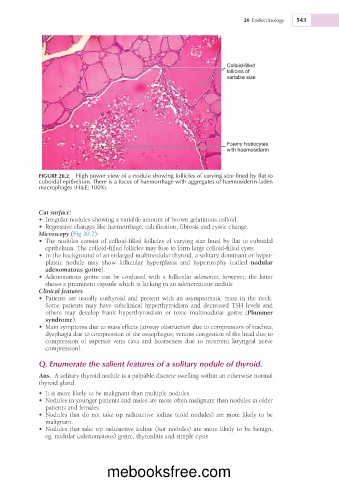
             FIGURE 20.2.  High power view of a nodule showing follicles of varying size lined by flat to
             cuboidal epithelium. There is a focus of haemorrhage with aggregates of haemosiderin-laden
             macrophages (H&E; 100X).


             Cut surface:
             •	 Irregular nodules showing a variable amount of brown gelatinous colloid.
             •	 Regressive changes like haemorrhage, calcification, fibrosis and cystic change.
             Microscopy (Fig 20.2):
             •	 The nodules consist of colloid-filled follicles of varying size lined by flat to cuboidal
               epithelium. The colloid-filled follicles may fuse to form large colloid-filled cysts.
             •	 In the background of an enlarged multinodular thyroid, a solitary dominant or hyper-
               plastic  nodule  may  show  follicular  hyperplasia  and  hypertrophy  (called  nodular
               adenomatous	goitre).
             •	 Adenomatous  goitre  can  be  confused  with  a  follicular  adenoma;  however,  the  latter
               shows a prominent capsule which is lacking in an adenomatous nodule.
             Clinical features
             •	 Patients  are  usually  euthyroid  and  present  with  an  asymptomatic  mass  in  the  neck.
               Some  patients  may  have  subclinical  hyperthyroidism  and  decreased  TSH  levels  and
               others  may  develop  frank  hyperthyroidism  or  toxic  multinodular  goitre  (Plummer
               syndrome).
             •	 Main symptoms due to mass effects (airway obstruction due to compression of trachea;
               dysphagia due to compression of the oesophagus; venous congestion of the head due to
               compression  of  superior  vena  cava  and  hoarseness  due  to  recurrent  laryngeal  nerve
               compression).

             Q. Enumerate the salient features of a solitary nodule of thyroid.

             Ans.	 A solitary thyroid nodule is a palpable discrete swelling within an otherwise normal
             thyroid gland.
             •	 It is more likely to be malignant than multiple nodules.
             •	 Nodules in younger patients and males are more often malignant than nodules in older
               patients and females.
             •	 Nodules that do not take up radioactive iodine (cold nodules) are more likely to be
               malignant.
             •	 Nodules that take up radioactive iodine (hot nodules) are more likely to be benign,
               eg, nodular (adenomatous) goitre, thyroiditis and simple cysts.


                                  mebooksfree.com

