


Page 559 - Concise Pathology for Exam Preparation ( PDFDrive )
P. 559
544    SECTION II  Diseases of Organ Systems

                     Q.  Write  briefly  on  the  pathogenesis  and  clinicomorphological
                     features of adenomas of thyroid.
                     Ans.	 Adenomas are discrete, solitary masses derived from the follicular epithelium (thus,
                     also called follicular adenomas). Hormone production in functional adenomas (also called
                     toxic adenomas) is independent of TSH stimulation. This is labelled thyroid autonomy.
                     Majority of the adenomas are nonfunctional (take up less iodine than normal thyroid tissue
                     and appear as cold nodules). Functioning adenomas appear as hot nodules.
                     Pathogenesis	of	Nonfunctioning	Adenomas
                     Nonfunctioning adenomas may have any of the following genetic alterations:
                       1.  Mutations in RAS proto-oncogene
                       2.  Phosphatidylinositol-3-kinase subunit abnormalities
                       3.  PAX8-PPARG fusion gene alterations
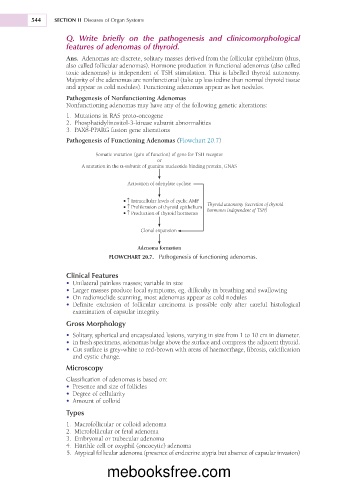
                     Pathogenesis	of	Functioning	Adenomas (Flowchart 20.7)

                              Somatic mutation (gain of function) of gene for TSH receptor
                                                 or
                          A mutation in the α-subunit of guanine nucleotide binding protein, GNAS


                                        Activation of adenylate cyclase

                                       • ↑ Intracellular levels of cyclic AMP  Thyroid autonomy (secretion of thyroid
                                       • ↑ Proliferation of thyroid epithelium  hormones independent of TSH)
                                       • ↑ Production of thyroid hormones


                                            Clonal expansion

                                           Adenoma formation
                                   FLOWCHART 20.7.  Pathogenesis of functioning adenomas.

                     Clinical Features
                     •	 Unilateral painless masses; variable in size
                     •	 Larger masses produce local symptoms, eg, difficulty in breathing and swallowing
                     •	 On radionuclide scanning, most adenomas appear as cold nodules
                     •	 Definite  exclusion  of  follicular  carcinoma  is  possible  only  after  careful  histological
                       examination of capsular integrity.
                     Gross Morphology

                     •	 Solitary, spherical and encapsulated lesions, varying in size from 1 to 10 cm in diameter.
                     •	 In fresh specimens, adenomas bulge above the surface and compress the adjacent thyroid.
                     •	 Cut surface is grey-white to red-brown with areas of haemorrhage, fibrosis, calcification
                       and cystic change.
                     Microscopy
                     Classification of adenomas is based on:
                     •	 Presence and size of follicles
                     •	 Degree of cellularity
                     •	 Amount of colloid
                     Types

                       1.  Macrofollicular or colloid adenoma
                       2.  Microfollicular or fetal adenoma
                       3.  Embryonal or trabecular adenoma
                       4.  Hürthle cell or oxyphil (oncocytic) adenoma
                      5.  Atypical follicular adenoma (presence of endocrine atypia but absence of capsular invasion)


                                  mebooksfree.com

