


Page 58 - Concise Pathology for Exam Preparation ( PDFDrive )
P. 58
2  Acute and Chronic Inflammation  43


               sites of infection or injury, however, to trigger a series of potent inflammatory events.
               Their action occurs via three pathways:
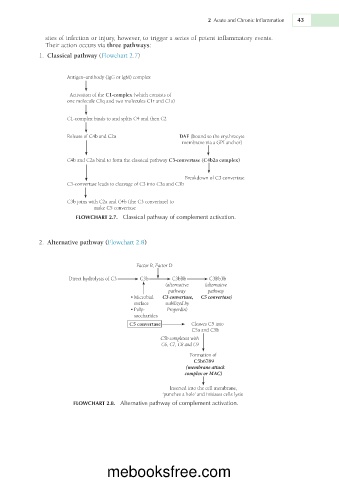
               1.  Classical pathway (Flowchart 2.7)


                      Antigen–antibody (IgG or IgM) complex


                        Activation of the C1-complex (which consists of
                      one molecule C1q and two molecules C1r and C1s)

                      C1-complex binds to and splits C4 and then C2


                      R   e s a e l e  f o  C  b 4  n a  d  C  a 2  DAF (bound to the erythrocyte
                                                         m e m  e n a r b  a i v  a  G  h c n a I P  ) r o

                      C4b and C2a bind to form the classical pathway C3-convertase (C4b2a complex)


                                                          Breakdown of C3 convertase
                      C3-convertase leads to cleavage of C3 into C3a and C3b

                      C3b joins with C2a and C4b (the C3 convertase) to
                                make C5 convertase
                        FLOWCHART 2.7.  Classical pathway of complement activation.


               2.  Alternative pathway (Flowchart 2.8)


                                           Factor B, Factor D

                      Direct hydrolysis of C3    C3b    C3bBb     C3Bb3b
                                                          e v i t a n r e t l a (     (alternative
                                                       h t a p  w  y a    pathway
                                         • Microbial   C3 convertase,   C5 convertase)
                                                 e c a f r u s  stabilized by
                                          P   •    - y l o  Properdin)
                                          saccharides
                                         C5 convertase                       Cleaves C5 into

                                                                           C5a and C5b
                                                  C5b complexes with
                                                   C6, C7, C8 and C9
                                                           Formation of
                                                             C5b6789
                                                          (membrane attack
                                                          complex or MAC)

                                                     Inserted into the cell membrane,
                                                   ‘punches a hole’ and initiates cells lysis
                        FLOWCHART 2.8.  Alternative pathway of complement activation.


                                  mebooksfree.com

