


Page 55 - Concise Pathology for Exam Preparation ( PDFDrive )
P. 55
40    SECTION I  General Pathology


                     •  Plasma-derived mediators are mainly produced in the liver; circulate in precursor form
                       and must be activated.
                     •  Cell-derived mediators are synthesized de novo or are preformed and stored in intracel-
                       lular granules and need to be secreted.
                     •  Production of active mediators is triggered by microbial products or by host proteins,
                       such as proteins of the complement, kinin and coagulation systems that are themselves
                       activated by microbes and damaged tissue.
                     •  Most mediators act by binding to specific receptors on target cells; one mediator can
                       stimulate release of other mediators.
                     •  Once activated and released from the cells, most of these mediators are short-lived.
                     •  The various mechanisms underlying their action include
                       •  Receptor–ligand interactions
                       •  Direct enzymatic activity
                       •  Oxidative damage

                     Q. Enumerate the steps involved in generation of arachidonic acid
                     metabolites.
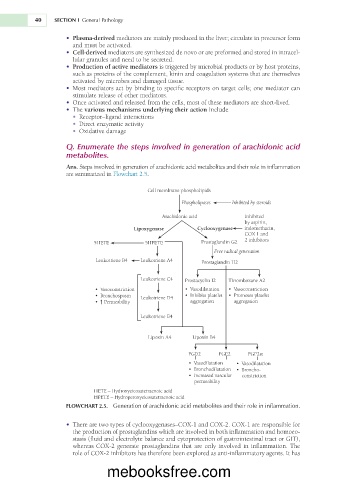
                     Ans. Steps involved in generation of arachidonic acid metabolites and their role in inflammation
                     are summarized in Flowchart 2.5.

                                              Cell membrane phospholipids
                                                         Phospholipases  Inhibited by steroids

                                                   Arachidonic acid         Inhibited
                                                                            by aspirin,
                                          Lipoxygenase        Cyclooxygenase   indomethacin,
                                                                            COX 1 and
                                                                            2 inhibitors
                              5HETE           5HPETE           Prostaglandin G2
                                                                   Free radical generation
                               Leukotriene B4    Leukotriene A4   Prostaglandin H2

                                            Leukotriene C4   Prostacyclin I2  Thromboxane A2
                              •  Vasoconstriction         •  Vasodilatation  •  Vasoconstriction
                              •  Bronchospasm  Leukotriene D4  •  Inhibits platelet  •  Promotes platelet

                              • ↑ Permeability                aggregation      aggregation
                                            Leukotriene E4


                                               Lipoxin A4   Lipoxin B4


                                                           PGD2     PGE2     PGF2α
                                                           •  Vasodilatation  •  Vasodilatation
                                                           •  Bronchodilatation  •  Broncho-
                                                           •  Increased vascular      constriction
                                                               permeability
                              HETE – Hydroxyeicosatetraenoic acid
                              HPETE – Hydroperoxyeicosatetraenoic acid
                     FLOWCHART 2.5.  Generation of arachidonic acid metabolites and their role in inflammation.


                     •  There are two types of cyclooxygenases–COX-1 and COX-2. COX-1 are responsible for
                       the production of prostaglandins which are involved in both inflammation and homoeo-
                       stasis (fluid and electrolyte balance and cytoprotection of gastrointestinal tract or GIT),
                       whereas COX-2 generate prostaglandins that are only involved in inflammation. The
                       role of COX-2 inhibitors has therefore been explored as anti-inflammatory agents. It has


                                  mebooksfree.com

