


Page 60 - Concise Pathology for Exam Preparation ( PDFDrive )
P. 60
2  Acute and Chronic Inflammation  45


                                Factor XII (Hageman factor)
                            High molecular weight  Collagen, basement membrane,
                             Kininogen (HMWK)  activated platelets

                                      Factor XIIa

                          Kinin cascade XIIa  Clotting cascade XIIa

                       Kallikrein   Prekallikrein  Factor XI    XIa

                                                 Factor X      Xa
                       HMWK

                          Fibrinolytic system    Prothrombin (II)   Thrombin (IIa)

                          Plasminogen     Plasmin     Fibrin     Fibrinogen


                      Bradykinin     Complement cascade  Fibrin split products

                                        C3     C3a
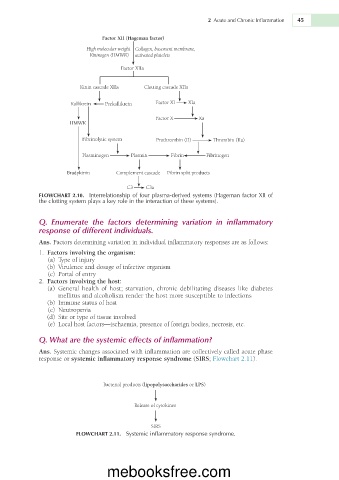
             FLOWCHART 2.10.  Interrelationship of four plasma-derived systems (Hageman factor XII of
             the clotting system plays a key role in the interaction of these systems).


             Q.  Enumerate  the  factors  determining  variation  in  inflammatory
             response of different individuals.

             Ans. Factors determining variation in individual inflammatory responses are as follows:
               1.  Factors involving the organism:
                 (a)  Type of injury
                 (b)  Virulence and dosage of infective organism
                 (c)  Portal of entry
               2.  Factors involving the host:
                 (a)  General health of host; starvation, chronic debilitating diseases like diabetes
                   mellitus and alcoholism render the host more susceptible to infections
                 (b)  Immune status of host
                 (c)  Neutropenia
                  (d)  Site or type of tissue involved
                 (e)  Local host factors—ischaemia, presence of foreign bodies, necrosis, etc.
             Q. What are the systemic effects of inflammation?

             Ans. Systemic changes associated with inflammation are collectively called acute phase
             response or systemic inflammatory response syndrome (SIRS; Flowchart 2.11).


                                 Bacterial products (lipopolysaccharides or LPS)


                                          Release of cytokines


                                                SIRS
                        FLOWCHART 2.11.  Systemic inflammatory response syndrome.


                                  mebooksfree.com

