


Page 53 - Concise Pathology for Exam Preparation ( PDFDrive )
P. 53
38    SECTION I  General Pathology


                         (b)  The oxygen-dependent MPO system is the most potent bactericidal mechanism
                           available to neutrophils and monocytes.
                        Other constituents of leukocyte granules which are also capable of killing microorgan-
                     isms include
                     •  Bactericidal/permeability-increasing (causes phospholipase activation and degradation
                       of phospholipids)
                     •  Lysozymes (causes degradation of bacterial coat oligosaccharides)
                     •  Major  basic  protein  (important  eosinophilic  granule  constituent,  which  is  toxic  to
                       parasites)
                     •  Defensins (peptides that kill microbes by creating holes in their membranes)
                     •  Neutrophil extracellular taps or NETs (Extracellular fibrillary networks consisting a
                       viscous meshwork of nuclear chromatin of neutrophils that trap the microbe at the site
                       of infection by fibrils and prevent their spread)


                                                          Phagosome
                                      Bacteria                       Lysosomes

                                                                       Phagolysosome
                                                Engulfment  Phagosome
                                Nucleus       Lysosomes    formation


                                Macrophage
                                                      Debris

                                            Egestion of debris  Killing and digestion
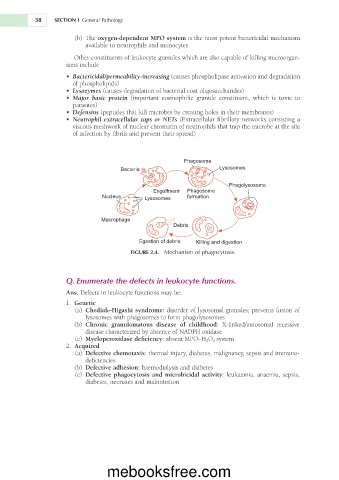
                                         FIGURE 2.4.  Mechanism of phagocytosis.


                     Q. Enumerate the defects in leukocyte functions.

                     Ans. Defects in leukocyte functions may be:
                       1.  Genetic
                         (a)  Chediak–Higashi syndrome: disorder of lysosomal granules; prevents fusion of
                           lysosomes with phagosomes to form phagolysosomes
                         (b)  Chronic  granulomatous  disease  of  childhood:  X-linked/autosomal  recessive
                           disease characterized by absence of NADPH oxidase
                         (c)  Myeloperoxidase deficiency: absent MPO–H 2 O 2  system
                       2.  Acquired
                         (a)  Defective chemotaxis: thermal injury, diabetes, malignancy, sepsis and immuno-
                           deficiencies
                         (b)  Defective adhesion: haemodialysis and diabetes
                         (c)  Defective phagocytosis and microbicidal activity: leukaemia, anaemia, sepsis,
                           diabetes, neonates and malnutrition


                                  mebooksfree.com

