


Page 63 - Concise Pathology for Exam Preparation ( PDFDrive )
P. 63
48    SECTION I  General Pathology

                     Causes

                       1.  Persistent infections, such as tuberculosis, syphilis, infections due to certain viruses,
                        fungi and parasites. Typically, these organisms
                         (a)  Are of low toxicity.
                         (b)  Evoke an immune response called delayed hypersensitivity.
                         (c)  Are characterized by a specific inflammatory response called a granulomatous reaction.
                       2.  Prolonged exposure to potentially toxic agents:
                        Exogenous—Silica        Silicosis
                        Endogenous—Toxic lipid components       Atherosclerosis
                      3.  Autoimmunity: Immune reaction against one’s own antigens can result in chronic tissue
                        damage.

                     Morphologic Features of Chronic Inflammation
                       1.  Infiltration by mononuclear cells (lymphocytes, macrophages and plasma cells)
                       2.  Tissue destruction due to persistent offending agent/inflammation
                       3.  Healing by connective tissue replacement of damaged tissue includes proliferation of
                        blood vessels (angiogenesis and fibrosis)
                     Cells Involved in Chronic Inflammation
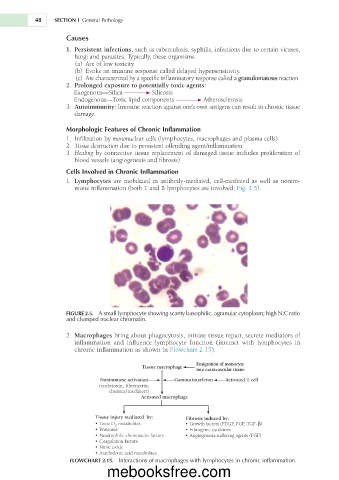
                       1.  Lymphocytes  are  mobilized  in  antibody-mediated,  cell-mediated  as  well  as  nonim-
                        mune inflammation (both T and B lymphocytes are involved; Fig. 2.5).


                     FIGURE 2.5.  A small lymphocyte showing scanty basophilic, agranular cytoplasm; high N:C ratio
                     and clumped nuclear chromatin.

                       2.  Macrophages bring about phagocytosis, initiate tissue repair, secrete mediators of
                        inflammation  and  influence  lymphocyte  function  (interact  with  lymphocytes  in
                        chronic inflammation as shown in Flowchart 2.15).

                                                             Emigration of monocyte
                                             Tissue macrophage
                                                             into extravascular tissue
                                 Nonimmune activation   G a m m  o r e f r e t n i a  n  Activated T cell
                                (endotoxin, fibronectin,
                                   chemical mediators)
                                            Activated macrophage


                              Tissue injury mediated  by:  Fibrosis induced by:
                              • Toxic O 2  metabolites    • Growth factors (PDGF, FGF, TGF- β)
                              • Proteases                 • Fibrogenic cytokines
                              • Neutrophilic chemotactic factors  • Angiogenesis-inducing agents (FGF)
                              • Coagulation factors
                              • Nitric oxide
                              • Arachidonic acid metabolites
                      FLOWCHART 2.15.  Interactions of macrophages with lymphocytes in chronic inflammation.
                                  mebooksfree.com

