


Page 56 - Concise Pathology for Exam Preparation ( PDFDrive )
P. 56
2  Acute and Chronic Inflammation  41


               been found that COX-2 may not be completely selective and may also play a role in
               homoeostasis  and  also  COX-2  inhibitors  may  increase  the  risk  of  cardiovascular
               and cerebrovascular events as they decrease endothelial production of Prostacyclin-I-2
               (vasodilator and inhibitor of platelet aggregation).
             •  Lipoxygenase is not affected by non-steroidal antiinflammatory drugs (NSAIDs). Inhibi-
               tors of this enzyme may be helpful in asthma as they inhibit production of leukotrienes.
             Q. Write briefly on platelet-derived factor (PAF).

             Ans. PAF is a bioactive phospholipid-derived mediator which has multiple inflammatory
             effects. It mediates its effects via a single G protein–coupled receptor and is regulated by
             a family of inactivating PAF acetyl hydrolases.
             •  Sources:
               •  Endothelial cells
               •  Platelets
               •  Neutrophils, basophils and monocytes
             •  Actions/effects:
               •  Vasoconstriction
               •  Bronchospasm
               •  Leukocyte adhesion to endothelium
               •  Chemotaxis
               •  Degranulation
               •  Oxidative burst
               •  Synthesis of mediators, eg, eicosanoids
             Q. What are cytokines? Describe their role in inflammation.

             Ans. Cytokines are messenger proteins secreted by some cell types (activated lymphocytes,
             macrophages, endothelial, epithelial and connective tissue cells) which modulate the func-
             tion of other cell types.
             •  TNF and IL-1 are the prototypes.
             •  TNF mediates the effects of septic shock (causes hypotension, g vascular resistance,
               h heart rate and g blood pH). It was earlier classified into TNF-a and -b. Presently,
               TNF-a is actually considered TNF; TNF-b is thought to be a lymphotoxin (produced
               by activated T lymphocytes). Secretion of TNF and IL1 is induced by:
               •  Bacterial products
               •  Immune complexes
               •  Toxins
               •  Cytokines
               •  Physical injury
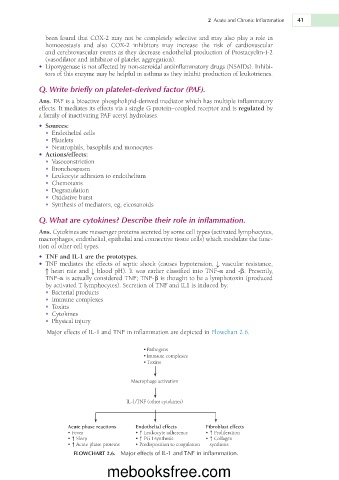
               Major effects of IL-1 and TNF in inflammation are depicted in Flowchart 2.6.


                                             •Pathogens
                                             •Immune complexes
                                             •Toxins


                                         Macrophage activation


                                        IL-1/TNF (other cytokines)


                      Acute phase reactions  Endothelial effects  Fibroblast effects
                      • Fever              • ↑ Leukocyte adherence  • ↑ Proliferation
                      • ↑ Sleep            • ↑ PG I synthesis   • ↑ Collagen
                      • ↑ Acute phase proteins  • Predisposition to coagulation     synthesis
                        FLOWCHART 2.6.  Major effects of IL-1 and TNF in inflammation.


                                  mebooksfree.com

