


Page 588 - Concise Pathology for Exam Preparation ( PDFDrive )
P. 588
21  Musculoskeletal System  573


                                                                         Dead
                                                                         bone


                                                                         Chronic
                                                                         inflammatory
                                                                         cells


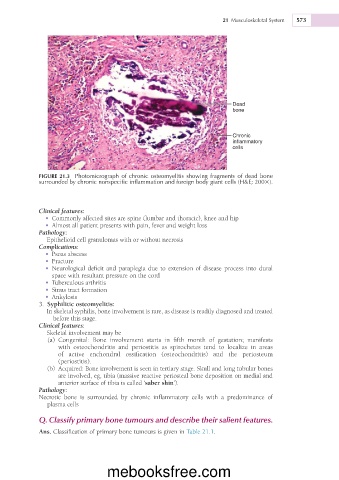
             FIGURE  21.3  Photomicrograph  of  chronic  osteomyelitis  showing  fragments  of  dead  bone
             surrounded by chronic nonspecific inflammation and foreign body giant cells (H&E; 2003).


             Clinical features:
               •	 Commonly affected sites are spine (lumbar and thoracic), knee and hip
               •	 Almost all patient presents with pain, fever and weight loss
             Pathology:
               Epithelioid cell granulomas with or without necrosis
             Complications:
               •	 Psoas abscess
               •	 Fracture
               •	 Neurological deficit and paraplegia due to extension of disease process into dural
                 space with resultant pressure on the cord
               •	 Tuberculous arthritis
               •	 Sinus tract formation
               •	 Ankylosis
               3.  Syphilitic	osteomyelitis:
               In skeletal syphilis, bone involvement is rare, as disease is readily diagnosed and treated
                 before this stage.
             Clinical features:
               Skeletal involvement may be
                 (a)  Congenital:  Bone  involvement  starts  in  fifth  month  of  gestation;  manifests
                   with  osteochondritis  and  periostitis  as  spirochetes  tend  to  localize  in  areas
                   of  active  enchondral  ossification  (osteochondritis)  and  the  periosteum
                   (periostitis).
                 (b)  Acquired: Bone involvement is seen in tertiary stage. Skull and long tubular bones
                   are involved, eg, tibia (massive reactive periosteal bone deposition on medial and
                   anterior surface of tibia is called ‘saber	shin’).
             Pathology:
             Necrotic  bone  is  surrounded  by  chronic  inflammatory  cells  with  a  predominance  of
                plasma cells

             Q. Classify primary bone tumours and describe their salient features.
             Ans. Classification of primary bone tumours is given in Table 21.1.


                                  mebooksfree.com

