


Page 587 - Concise Pathology for Exam Preparation ( PDFDrive )
P. 587
572    SECTION II  Diseases of Organ Systems


                     Complications:
                          1.  Draining sinus tract
                          2.  Suppurative arthritis
                          3.  Pathological fracture
                          4.  Secondary ankylosis (fibrosis and fusion of joint)
                          5.  Endocarditis
                          6.  Squamous cell carcinoma with a chronic nonhealing ulcer (Marjolin ulcer)
                     Clinical features:
                        Fever, leucocytosis and throbbing pain over the affected region (differential	diagnosis:
                          is Ewing sarcoma as it may have a similar clinical presentation)
                     X-ray:
                        Lytic focus surrounded by sclerosis.
                     Clinicomorphological variants of osteomyelitis:
                     Chronic	osteomyelitis results from inadequate antibiotic treatment or incomplete surgi-
                       cal debridement. Extensive periosteal reactive bone formation associated with chronic
                       osteomyelitis is called involucrum.
                     Brodie	abscess	is a small devascularized osteomyelitic focus which becomes encapsulated
                       and surrounded by dense sclerotic reactive bone.
                     Sclerosing	 osteomyelitis	 of	 Garre typically develops in the jaw, and is associated
                       with extensive new bone formation that obscures many of the underlying osseous
                       structures.
                       2.  Tuberculous	osteomyelitis:
                     1–3%  cases  of  pulmonary  and  extrapulmonary  tuberculosis  present  with  osseous
                        involvement. Age group affected is adolescents and young adults. Skeletal tuberculosis
                        usually presents as a solitary lesion but may be multifocal in immunodeficient state,
                        eg, AIDS.
                     Modes of spread:
                       •	 Haematogenous (from active visceral disease)
                       •	 Direct extension (from a pulmonary focus into the ribs or tracheobronchial nodes
                         into the vertebrae)


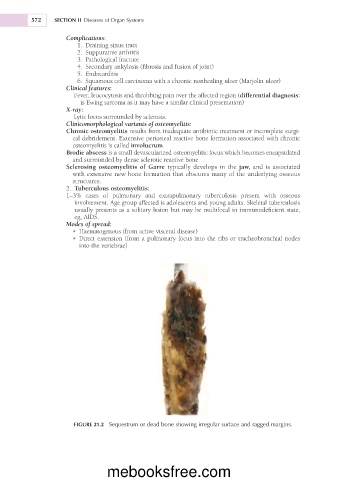
                        FIGURE 21.2  Sequestrum or dead bone showing irregular surface and ragged margins.


                                  mebooksfree.com

