


Page 600 - Concise Pathology for Exam Preparation ( PDFDrive )
P. 600
21  Musculoskeletal System  585


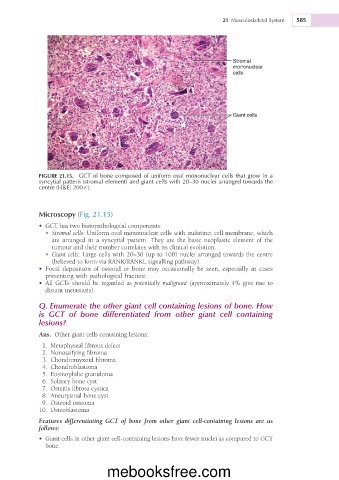
                                                                         Stromal
                                                                         mononuclear
                                                                         cells


                                                                         Giant cells


             FIGURE 21.15.  GCT of bone composed of uniform oval mononuclear cells that grow in a
             syncytial pattern (stromal element) and giant cells with 20–30 nuclei arranged towards the
             centre (H&E; 2003).


             Microscopy (Fig. 21.15)

             •	 GCT has two histopathological components:
               •	 Stromal cells: Uniform oval mononuclear cells with indistinct cell membrane, which
                 are  arranged  in  a  syncytial  pattern.  They  are  the  basic  neoplastic  element  of  the
                 tumour and their number correlates with its clinical evolution.
               •	 Giant cells: Large cells with 20–30 (up to 100) nuclei arranged towards the centre
                 (believed to form via RANK/RANKL signalling pathway).
             •	 Focal  deposition  of  osteoid  or  bone  may  occasionally  be  seen,  especially  in  cases
               presenting with pathological fracture.
             •	 All GCTs should be regarded as potentially malignant (approximately 4% give rise to
               distant metastasis).

             Q. Enumerate the other giant cell containing lesions of bone. How
             is  GCT  of  bone  differentiated  from  other  giant  cell  containing
             lesions?

             Ans.  Other giant cells containing lesions:
               1.  Metaphyseal fibrous defect
               2.  Nonossifying fibroma
               3.  Chondromyxoid fibroma
               4.  Chondroblastoma
               5.  Eosinophilic granuloma
               6.  Solitary bone cyst
               7.  Osteitis fibrosa cystica
               8.  Aneurysmal bone cyst
               9.  Osteoid osteoma
               10.  Osteoblastoma
             Features  differentiating  GCT  of  bone  from  other  giant  cell-containing  lesions  are  as
             follows:
             •	 Giant cells in other giant cell-containing lesions have fewer nuclei as compared to GCT
               bone.


                                  mebooksfree.com

