


Page 602 - Concise Pathology for Exam Preparation ( PDFDrive )
P. 602
21  Musculoskeletal System  587


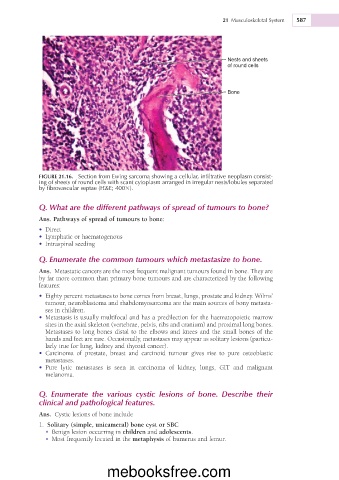
                                                                       Nests and sheets
                                                                       of round cells


                                                                       Bone


             FIGURE 21.16.  Section from Ewing sarcoma showing a cellular, infiltrative neoplasm consist-
             ing of sheets of round cells with scant cytoplasm arranged in irregular nests/lobules separated
             by fibrovascular septae (H&E; 4003).

             Q. What are the different pathways of spread of tumours to bone?
             Ans.	Pathways	of	spread	of	tumours	to	bone:
             •	 Direct
             •	 Lymphatic or haematogenous
             •	 Intraspinal seeding

             Q. Enumerate the common tumours which metastasize to bone.
             Ans.  Metastatic cancers are the most frequent malignant tumours found in bone. They are
             by far more common than primary bone tumours and are characterized by the following
             features:
             •	 Eighty percent metastases to bone comes from breast, lungs, prostate and kidney. Wilms’
               tumour, neuroblastoma and rhabdomyosarcoma are the main sources of bony metasta-
               ses in children.
             •	 Metastasis is usually multifocal and has a predilection for the haematopoietic marrow
               sites in the axial skeleton (vertebrae, pelvis, ribs and cranium) and proximal long bones.
               Metastases to long bones distal to the elbows and knees and the small bones of the
               hands and feet are rare. Occasionally, metastases may appear as solitary lesions (particu-
               larly true for lung, kidney and thyroid cancer).
             •	 Carcinoma  of  prostate,  breast  and  carcinoid  tumour  gives  rise  to  pure  osteoblastic
               metastases.
             •	 Pure  lytic  metastases  is  seen  in  carcinoma  of  kidney,  lungs,  GIT  and  malignant
               melanoma.


             Q.  Enumerate  the  various  cystic  lesions  of  bone.  Describe  their
             clinical and pathological features.

             Ans.  Cystic lesions of bone include
               1.  Solitary	(simple,	unicameral)	bone	cyst	or	SBC
               •	 Benign lesion occurring in children and adolescents.
               •	 Most frequently located in the metaphysis of humerus and femur.


                                  mebooksfree.com

